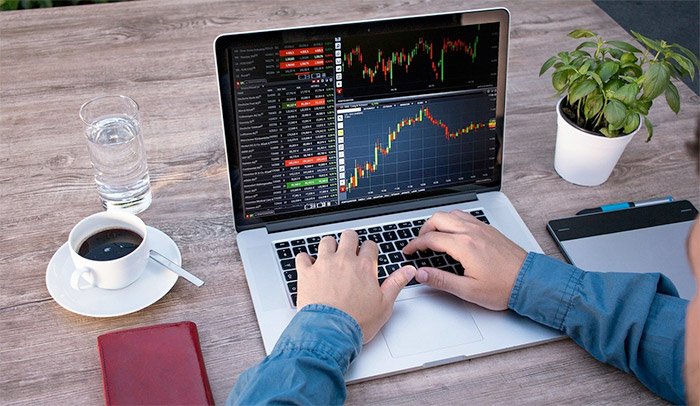
Forex Trading Explained: A Beginner’s Guide
Forex trading involves buying and selling currencies to profit from price movements in the global foreign exchange market. To understand the basics of how the forex market operates, including how currencies are priced and traded, see our explanation of what forex trading is.
As one of the largest financial markets in the world, forex trading attracts both individual and institutional participants. To get started, it is essential to understand how the market works, the risks involved and how to choose a reliable broker.
In this guide, you will learn:
- How forex trading works
- The key risks involved
- How to get started step by step
Forex trading has become one of the most accessible ways to participate in the financial markets. Each day, millions of traders open and close positions on currency pairs through CFD trading platforms, which allow them to speculate on price movements without owning the underlying asset.
The foreign exchange market operates 24 hours a day, five days a week, offering continuous opportunities to trade across global sessions.
In this guide, we walk you through the fundamentals of forex trading, helping you understand how the market works, how trades are executed, and what to consider before getting started. Whether you are starting from scratch or building on some initial experience, this guide is designed to give you a clear and reliable foundation.
Forex trading carries a high level of risk, particularly when leverage is used, and may not be suitable for all investors.
What is the Forex Market?
The forex market, also known as FX, is where traders and institutions speculate on the relative value of currencies. It is the largest and most liquid market in the world, with trillions of dollars traded every day. Unlike the stock market, which is tied to exchanges like the London Stock Exchange or New York Stock Exchange, forex has no centralised exchange.
Forex operates over-the-counter (OTC) via a global network of banks, brokers and financial entities. With trading hubs in London, New York, Tokyo and Sydney, the market rolls seamlessly across time zones, meaning that when one region sleeps, another region opens. In essence, there is round-the-clock activity.
How Does Forex Work?
Forex trading is always conducted in pairs, such as GBP/USD or EUR/JPY. When you trade a pair, you speculate on whether the base currency (the first in the pair) will rise or fall against the quote currency (the second).
For example, ‘going long’ on GBP/USD means that you expect the pound to strengthen against the dollar. ‘Going short’ on the same pair means you anticipate the opposite will happen. Prices fluctuate constantly in response to economic data, central bank policy changes, political events and market sentiment.
To stay updated on these developments, you can follow our latest market news and analysis section, where we cover key economic and news releases and their impact on financial markets.
Retail traders typically access forex through CFDs, which allow them to trade on these price movements without owning the underlying currencies. When you trade using leverage, you only need to commit a fraction of the full trade value. This is risky as it may amplify profits, but also potential losses.
Who Trades Forex?
Historically, forex trading was undertaken by banks, investment institutions and large corporations. Today, traders can trade using online platforms, which has made participation more accessible.
Institutions often use forex to manage risk or hedge exposure, whilst retail traders are attracted to the liquidity and flexibility of the market. Banks may wish to protect themselves against exchange rate swings and individuals may wish to speculate on short-term price movements. Both drive constant market activity.
What is Forex Trading?
Forex trading is about speculating on the movement of exchange rates with the aim of making a profit. Rather than physically exchanging one currency for another, traders open positions on popular pairs like EUR/USD or USD/JPY. If you believe the euro will strengthen against the dollar, you would open a long position on EUR/USD. If you expect it to weaken, you would go short instead.
To trade forex, you will need to open an account with a regulated broker, for example, EC Markets.
How to Start Trading Forex
If you are new to forex trading, you would do well to familiarise yourself with the basics so that you understand how currency pairs work, how they are quoted and what could possibly influence price changes.
You should also pick a fully licensed and regulated broker who has a strong reputation and offers excellent client support. You may also wish to consider the trading platform each broker offers – usually MT4 and MT5 are standard. Many brokers provide MetaTrader 4 or proprietary platforms, like EC Markets.
Finally, we would strongly advise creating a demo account so you can test strategies and familiarise yourself with the trading environment.
This gradual approach allows you to gain knowledge and confidence before risking your real capital. If you’re ready to get started, check out our recommended brokers for beginners or our Best Forex Brokers 2026 – reviewed and rated here on FXTrustScore.com
How to Profit from Trading Forex
Profitable forex trading is built on analysis, strategy and discipline. Generally, traders can benefit from keep a watching on on two main types of analysis; technical analysis and fundamental analysis.
Daily technical analysis is studying price charts (present and historic), patterns and economic indicators in order to forecast potential moves.
Fundamental analysis is something that most reputable brokers offer for free in order to support their clients. This is where an internal analyst assesses economic releases, interest rate decisions and political developments. In most cases, analysts may also share what they personally believe will be the impact on certain currencies or assets.
You can read similar expert commentary and weekly updates in our Market News hub which provides ongoing insight into how macroeconomic events influence forex trends.
Traders also use stop-loss orders, limit leverage and follow a structured plan help protect their funds. The most successful traders combine analysis and patience, focusing on consistency rather than short-lived wins.
Basic Forex Trading Strategies
As a forex traders, you may use different strategies depending on your goals and how much time you have available. Four of the most common strategies are:
Day Trading
Opening and closing positions within the same day, capturing short-term movements. This option is quite intensive and requires close attention to price action.
Swing Trading
Holding positions for a few days or weeks to capture medium-term swings. Swing trading is less time-intensive than day trading, so it tends to be more popular amongst part-time traders.
Position Trading
Position trading focuses on long-term trends and keeps positions open for months or even years. Position traders rely heavily on fundamental analysis.
Scalp Trading
Scalp trading is essentially executing multiple trades in a single day so as to profit from very small price movements. This option is more fast-paced and requires discipline and precision as well as keeping a constant eye on any economic or political factors which may influence the market.
Key Forex Terminology
Before you start trading forex, it is important to learn the common trading terminology. Here are some to get you started:
Forex Account
The account you open with a broker to trade currency pairs via CFDs.
Spread
A spread is the small gap between the price you buy at and the price you sell at and it is a basic cost of trading. Spreads during volatile market conditions do not always behave the same way as they do in calmer markets, which can significantly affect execution and trading costs.
Bid
The price at which you can sell a pair (open a short position).
Ask
The price at which you can buy a pair (open a long position). The difference is known as the spread.
Contract for Difference (CFD)
A derivative that allows you to speculate on price movements without owning the underlying currency or asset.
Leverage
Borrowed funds that let you control a larger position than your deposit covers. This magnifies both gains and losses.
Live Forex Charts
Charts showing real-time and historical prices to help traders identifiy and analyse trends as a basis for planning strategy and opening and closing of positions.
Which Currencies Can I Trade In?
Forex offers a wide range of pairs, grouped into majors, minors and exotic pairs. These are typically listed on the broker’s website and almost certainly within the broker’s client area.
Major pairs include the US dollar and dominate forex trading volume, for example; EUR/USD, GBP/USD and USD/JPY. These are the most highly traded pairs in the world.
Minor pairs exclude the dollar, such as EUR/GBP and AUD/NZD.
Exotic pairs involve one major currency and one from an emerging market such as USD/TRY (Turkish lira) or USD/ZAR (South African rand). These are generally more volatile and carry higher spreads, but they also present unique opportunities.
Pros and Cons of Trading Forex
Pros | Cons |
High liquidity which makes it easy to enter and exit trades | Volatility can lead to loss. |
Lower trading costs compared to many other markets | Leverage amplifies both risks and rewards |
24/5 trading which offers flexibility | Influenced by sudden global events which can destabilise positions. |
How and Where Can I Learn Forex Trading in More Depth?
Learning forex and trading forex successfully is an ongoing process. The market and economy is constantly changing and strategies that worked once, may not be as effective the second time around. Fortunately, reputable brokers offer extensive educational resources to assist traders.
Keeping up with current market events is equally important – our Market News section helps traders apply their learning to real-world scenarios.
Forex Trading Courses
Trading courses are one of the most popular ways to get started if you are a beginner. A good beginner’s course will take you through all the fundamentals such as how currency pairs work, what drives price movements and how to manage risk. More advanced courses will cover topics such as technical charting, trading psychology and even portfolio management. Most courses are available online which means you can learn at your own pace.
Forex Webinars
Webinars are live sessions led by experienced representatives of your chosen broker or affiliated and approved traders. Webinars are particularly useful and constructive because they give traders the opportunity to ask questions and get them answered immediately. They also present a good opportunity to dive deeply into how to get started, and how to navigate global economic events and other influences.
Forex Broker Educational Resources
Most reputable forex brokers now provide extensive educational resources on their websites or within their client areas. Many offer written guides, video tutorials and podcasts. Many brokers also offer demo accounts where you can practise your strategies and familiarise yourself with the platform, in a risk-free environment.
Wrapping up: Final Thoughts
Forex trading for beginners can feel complex and overwhelming, however, with the right knowledge and preparation, it becomes far more approachable. With practise, especially using a demo trading environment, you are sure to gain and build the confidence you need.
We hope this guide has helped you take the first step. To continue building your knowledge, you may wish to explore our next article: Leverage in Trading Forex.
You can also stay informed by following the Market News updates we publish regularly, covering global market movements and forex insights.
FAQs
Forex trading for beginners is the practice of learning how to speculate on currency price movements using CFD trading platforms such as MT4 and MT5, in order to make a profit.
To start trading forex, beginners should learn the basics, choose a regulated and reputable broker, practise with a demo account before trading live and finally open a real account and fund it to start investing real capital.
Forex trading can be suitable for beginners if approached very carefully. Beginners should take the time to learn from educational resources, practice with a demo account and keep an eye on what is happening economically and politically. Please be aware that forex trading carries a high risk due to leverage and volatility.
The minimum amount varies according to each broker, but many allow beginners to start with a deposit between €10-€100. If using leverage, this amount increases. However, always trade only what you can afford to lose.
Yes you can make money trading as a beginner, but your success depends on a variety of factors including your knowledge, strategy and discipline. As a beginner, it is constructive give adequate time to learning and practising with a demo account, before risking your real money.
Publication date:
01/10/2025
Author: FX Trust Score
Last updated on May 11, 2026