Tesla is expanding its focus on AI and robotics, signalling a shift beyond its core EV business as investors reassess its long-term growth strategy.

Tesla is drawing attention once more, as its long-term strategy moves further toward artificial intelligence and automation, reshaping how investors view the company’s future.
Recent results have highlighted a growing divide within Tesla’s business. This follows recent developments in Tesla’s core EV segment, which we examined in detail in our earlier coverage of demand trends.
Whilst earnings came in ahead of expectations, revenue fell short and vehicle deliveries failed to meet forecasts, pointing to a more complex environment for its core electric vehicle operations. At the same time, Tesla is accelerating investment in areas that sit well beyond traditional automotive manufacturing.
A Shift Toward AI and Automation
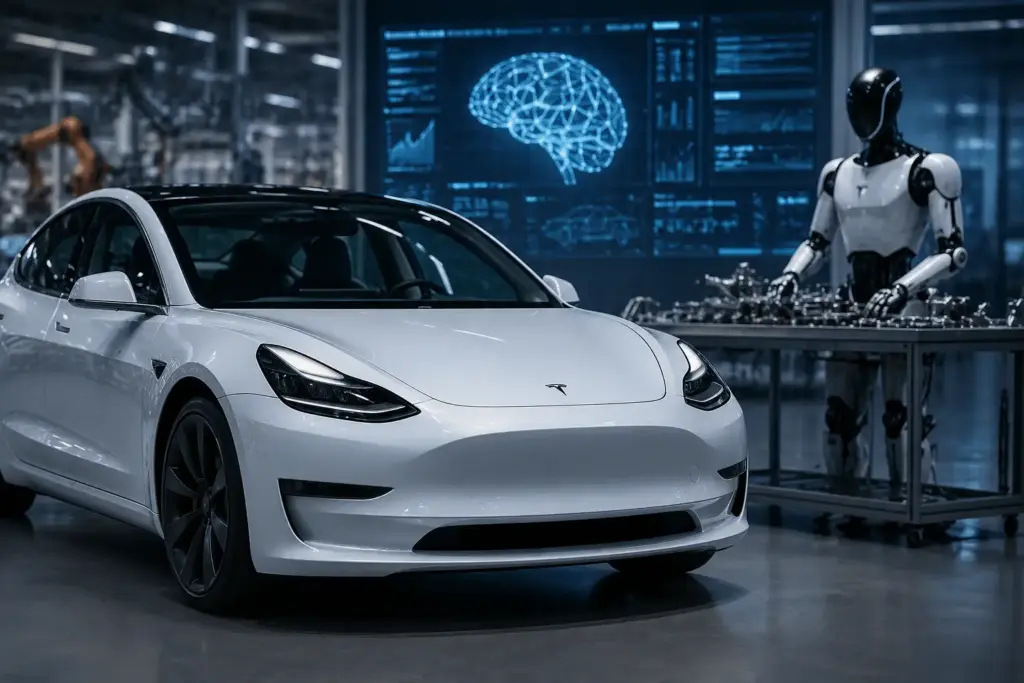
Tesla has significantly increased its capital expenditure plans, with spending expected to exceed $25 billion as the company expands its work in artificial intelligence, robotics and autonomous systems. This includes continued development of self-driving technology, humanoid robotics and custom AI hardware. The company has also disclosed a deal to acquire an AI hardware business valued at up to $2 billion, reinforcing its push into building the infrastructure required for these ambitions.
These strategic business moves point to a broader repositioning. Tesla is no longer being assessed purely on vehicle production and delivery growth, but increasingly on its ability to execute in emerging technology markets that remain largely unproven.
EV Business Still Matters
Despite this shift, Tesla’s core automotive business remains central to its near-term performance. Vehicle deliveries have come in below expectations and competition continues to intensify, particularly from Chinese manufacturers offering lower-cost alternatives.
Pricing dynamics and regional demand differences are adding further complexity, with broader cost pressures continuing to influence consumer behaviour across markets, and growth no longer following the more predictable trajectory seen in earlier phases of EV adoption.
For traders, this creates a layered narrative. Tesla is still a car company in terms of revenue, but its valuation increasingly reflects expectations tied to future technologies.
Market Reaction Reflects a Divided View
Tesla’s share price has responded to this evolving story with increased sensitivity. Investors are balancing short-term performance in the EV market against long-term expectations around AI, robotics and autonomy. The gap between those two narratives appears to have widened, contributing to more volatile sentiment and a broader range of analyst views.
Some see Tesla’s investment cycle as necessary to secure its next phase of growth. Others question whether the scale of spending can be justified in the absence of short-term returns.
What Traders Are Watching
Attention is now shifting toward execution. The key question is how quickly Tesla can translate its AI investments into tangible outcomes, whether through autonomous driving, robotaxi deployment or robotics.
Developments in its automotive business continue to act as a real-time measure of underlying demand and competitive positioning. Presently, Tesla sits between two identities – a maturing EV manufacturer and an ambitious technology platform – and how that balance evolves is likely to define market direction in the months ahead.
These developments are closely followed by traders working with trusted brokers to access global markets.