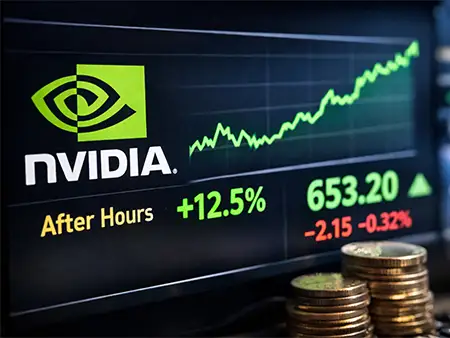
Artificial intelligence is still one of the market’s strongest long-term themes, but investors are approaching it with more discipline. Instead of chasing the hype, Wall Street is hedging AI exposure and shifting toward stronger fundamentals like infrastructure and cash-flow-driven tech.

Artificial intelligence has been the market’s favourite storyline for more than two years now. Every earnings season has included another company announcing an AI partnership, an AI pivot or an AI-powered anything. The narrative has been loud, relentless and impossible to ignore.
But going into 2026, the tone around AI has shifted. The fascination is still there, but the behaviour is different. Instead of piling aggressively into AI-linked stocks, many large investors are quietly hedging their exposure, trimming positions or rebalancing into areas with more predictable value. It’s not fear. It’s discipline, and it marks a new phase in how the market understands AI.
For more updates on global market trends and macro shifts, visit our Market News section.
The AI story hasn’t faded, but the risk profile has changed
The AI boom created extraordinary winners and until now, that has not changed. Chipmakers, infrastructure providers and a handful of software giants continue to dominate the conversation. Demand for compute power is still rising, data centres are still expanding and AI capabilities continue to leap forward.
What has changed is the level of confidence around valuations. The biggest funds and strategic investors are not betting on an AI collapse; they are preparing for a world where expectations may need to cool. AI is still considered transformative, but the market is no longer treating it as an endless fountain of upside. The question has shifted from “How big can this get?” to “How much of this is already priced in?”
Hedging is a sign of maturity (not panic)
When Wall Street hedges, it usually means one of two things: either something looks fragile or the market is reaching a point where uncertainty deserves respect. In the case of AI, it’s the second. Several factors are driving a more measured approach.
Firstly, the speed of price appreciation across AI-linked equities has outpaced earnings growth in many areas. The enthusiasm is very real, but fundamentals tend to catch up more slowly than headlines. Second, AI has moved from an early-cycle innovation story to a competitive arms race. Costs are rising. Compute requirements are enormous. Only a small group of companies can participate at scale. Investors increasingly recognise that not every AI-branded business will become a winner.
Thirdly, the macro environment is shifting. Lower interest rates create room for long-duration tech stories to outperform, but they also provide opportunities in other sectors that have been overshadowed by AI’s dominance.
The winners are evolving beyond “AI stocks”
One of the more interesting developments is where capital appears to be flowing now. The obsession with identifying “pure AI stocks” is fading and is being replaced by a broader, more strategic lens.
Investors are looking at:
Infrastructure: Data centres, energy providers and the hardware backbone powering AI systems.
Industrial technology: Companies that incorporate AI into supply chains, automation and manufacturing.
Risk-managed portfolios: Broader exposure across sectors that benefit indirectly from AI.
Cash-flow-generating tech: Firms that use AI but still maintain predictable, mature business models.
This is a more sustainable way of investing in the theme. Instead of chasing headlines, investors are focusing on where AI is actually creating long-term value.
Traders are responding differently from long-term investors
Short-term traders still see AI as one of the most tradable narratives in the market. Volatility is high, newsflow is constant and the sector reacts quickly to sentiment. For traders, AI remains an opportunity machine.
Long-term investors, however, are positioning for a decade-long transformation rather than a one-year rally. They’re less interested in the day-to-day noise and more focused on market structure: where the money is being spent, where capacity is constrained, and which companies will still be leaders when AI becomes as ordinary as cloud computing.
This divide between trading momentum and investment discipline is shaping the tone of the AI conversation heading into 2026. Newer traders who want to understand market moves from the ground up can explore our Forex Trading for Beginners guide.
Why caution and optimism can coexist
There is a misconception that hedging means pessimism. In reality, it simply signals awareness. AI is still expected to reshape entire industries, but the journey will involve uneven progress, fierce competition and inevitable periods of cooling.
Investors want exposure, but they also want protection. They want upside, but not at any cost. They want to participate in the AI era, but they don’t want to be swept away by its momentum.
This balance between optimism and caution is healthy. It means the market is beginning to treat AI like a real industry, rather than a speculative thrill. Things are moving fast.
The bottom line
AI investing is moving into its next chapter. The excitement remains, but it has matured. Wall Street is no longer chasing the story blindly; it is managing it thoughtfully.
For individual traders and investors, this shift offers an important lesson. AI remains one of the defining investment themes of our time, but the smartest players are not relying on hype. They are preparing for a market where AI continues to grow, but expectations become more realistic.
Investors are responding to rapid price increases, rising competition among AI leaders and shifting macro conditions. The long-term potential of AI remains strong, but valuations and expectations are being reassessed.
Not necessarily. Many are maintaining or slightly trimming positions while adding hedges or rebalancing into other sectors. It’s a shift toward discipline rather than a retreat.
Most major investors believe AI will remain one of the defining growth themes of the next decade. The change is not about the future of AI, but how aggressively to price it today.
Infrastructure related to AI, such as data centres, energy supply, hardware and automation technology is attracting significant attention thanks to more stable fundamentals.