Most retail traders interact with forex brokers through a simple interface; they open an account, deposit funds and place trades on a platform like MetaTrader 4 or MetaTrader 5. Understanding how forex brokers operate, and where prices and liquidity actually come from, can help traders make more informed decisions when choosing a broker. Traders can also compare trusted brokers in our dedicated section.
From the trader’s perspective, the process appears straightforward. Prices move, trades execute, profits or losses appear instantly.
However, behind this simple interface sits a complex institutional infrastructure involving banks, liquidity providers and specialised financial intermediaries. Understanding this “plumbing” can help traders better evaluate brokers and understand how trades are actually executed.
💡 This article is part of our Forex Education series, where we explain how the forex market works and how to evaluate brokers safely.
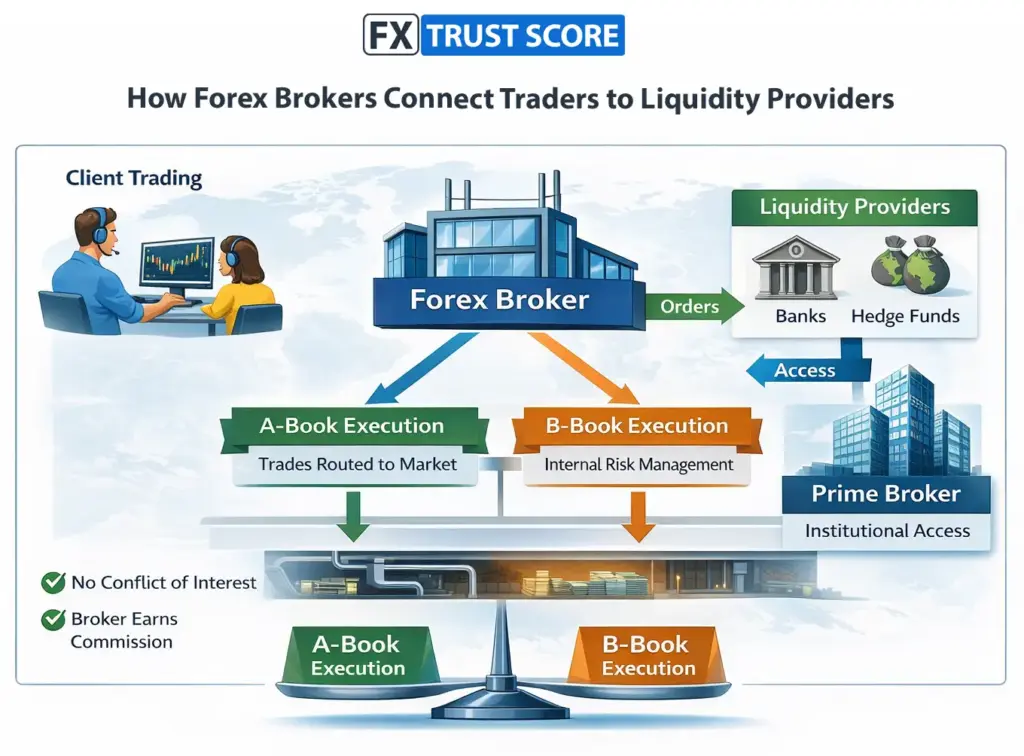
Image: The diagram above shows a simplified overview of how retail forex trading connects traders, brokers, liquidity providers and institutional counterparties.
How Forex Brokers Work (Quick Overview)
Forex brokers act as intermediaries between retail traders and the global foreign exchange market. They provide trading platforms, access to liquidity providers and margin trading infrastructure that allows traders to speculate on currency price movements. Behind every trade typically sits a network of:
liquidity providers such as global banks
prime brokers or prime-of-prime providers
trading servers and risk management systems
segregated client accounts for deposits
This infrastructure allows traders to access the forex market efficiently whilst brokers manage execution and risk behind the scenes.
What Happens When You Deposit Money with a Forex Broker
The first step in the trading process is depositing funds into a broker account.
When a trader deposits money with a regulated broker, those funds are typically placed in segregated client accounts held at third-party banks. Segregation means client funds must be kept separate from the broker’s operational funds.
Many financial regulators require this practice, including:
Financial Conduct Authority (United Kingdom)
Cyprus Securities and Exchange Commission (Cyprus)
Australian Securities and Investments Commission (Australia)
The purpose of fund segregation is to protect client deposits if a broker experiences financial difficulties.
It is important to note that client deposits do not move every time a trade is placed. Instead, they act as collateral for margin trading, allowing traders to open positions larger than their account balance.
Where Forex Prices Actually Come From
Retail brokers do not create forex prices independently. Instead, they receive price streams from liquidity providers. Liquidity providers are typically large financial institutions that continuously quote bid and ask prices for currency pairs.
Examples include:
Citigroup
JP Morgan
XTX Markets
These institutions form part of the global foreign exchange market, which is the largest financial market in the world.
Brokers typically connect to several liquidity providers simultaneously and aggregate their quotes. This aggregation process allows brokers to display competitive spreads and ensure sufficient liquidity for client trades.
The Hidden Layer Most Traders Never See: Prime Brokers
Most retail brokers cannot access tier-one bank liquidity directly. Large banks typically require very high capital levels and strict credit relationships. In order to bridge this gap, many brokers use prime brokers or prime-of-prime providers, including:
LMAX Group
CFH Clearing
IS Prime
These companies aggregate liquidity from multiple banks and make it accessible to retail brokers. They also perform several critical functions:
liquidity aggregation
credit intermediation
trade settlement
risk management
Essentially, prime brokers act as the institutional gateway connecting retail brokers to global FX liquidity.
What Happens When You Place a Trade on Metatrader
When a trader places an order on a trading platform, the order is sent to the broker’s trading server. The broker then decides how the trade will be executed.
In some cases, the broker passes the trade to external liquidity providers. In other cases, the broker may internally match or manage the exposure.
Regardless of the execution model, the key point is that client funds themselves do not move through the global currency market each time a trade is opened.
Instead, the broker manages exposure through margin accounting and hedging strategies.
Why Forex Trading Uses Margin Instead of Physical Currency
Forex trading through retail brokers is based on contracts rather than physical currency exchange. When a trader buys EUR/USD, they are not receiving euros in their account. Instead, they are entering a leveraged contract that reflects the price movement of the currency pair.
Due of this structure:
traders can control large positions with relatively small deposits
brokers can manage exposure efficiently
settlement between institutions occurs separately from client balances
This is one reason the retail forex market operates so efficiently despite extremely high trading volumes.
What Happens If a Broker Fails
One of the most important considerations for traders is the safety of their funds. Regulated brokers must typically maintain client funds in segregated accounts and comply with capital adequacy requirements.
In some jurisdictions, additional protections exist. For example, traders using UK-regulated brokers may be covered by the Financial Services Compensation Scheme. This scheme may compensate eligible clients if a regulated firm becomes insolvent.
However, protections vary depending on the regulator and jurisdiction, which is why choosing a well-regulated broker is critical. Evaluating these protections is an important part of assessing broker reliability, which is why the FXTrustScore methodology places significant weight on regulation, client fund protection and operational transparency.
Why Understanding Broker Infrastructure Matters
Many traders focus primarily on spreads, leverage or trading platforms when choosing a broker. Whilst these factors are important, the institutional infrastructure behind the broker can be just as significant. Key aspects traders should consider include:
regulatory oversight
segregation of client funds
liquidity provider relationships
execution quality
overall reputation
Understanding how brokers connect to the broader financial system can help traders make more informed decisions about where to open an account.
Why This Matters for Traders
Retail forex trading may appear simple on the surface, however, it operates within a sophisticated financial ecosystem involving banks, liquidity providers and specialised intermediaries.
Platforms like MetaTrader 4 and MetaTrader 5 provide the interface traders see, but the real activity occurs within a network of institutions that supply liquidity, manage risk, and ensure the market functions smoothly.
Understanding how brokers operate behind the scenes can help traders evaluate the safety and reliability of different firms. For example, our detailed review of EC Markets examines regulation, trading conditions and operational transparency.
Related Guides
FAQs
Forex brokers receive prices from liquidity providers such as banks and financial institutions. These quotes are aggregated to create the spreads traders see on their platforms.
Some brokers internalise trades while others pass them to liquidity providers. Many operate hybrid models depending on risk management and client trading behaviour.
Regulated brokers typically hold client deposits in segregated accounts at third-party banks, separate from the broker’s operating funds.
Retail forex trading is usually based on leveraged contracts rather than physical currency delivery.
Publication date:
10/03/2026
Author: FX Trust Score
Last updated on March 16, 2026