The foreign exchange market is the largest financial market in the world, with daily trading volumes exceeding trillions of dollars. Maintaining liquidity across such a large market requires constant price quotations from many participants.
Liquidity providers contribute to the market by:
- supplying continuous bid and ask prices
- absorbing trade flow from brokers and institutions
- helping maintain tight spreads
- supporting fast order execution
Without sufficient liquidity, traders would experience wider spreads and slower execution.
This guide is part of the FXTrustScore Education Series and explains what liquidity providers are, how brokers access institutional liquidity and how this affects pricing and execution in forex trading.
How Forex Brokers Access Liquidity
Retail forex brokers typically do not connect directly to large banks. Instead, they often access liquidity through intermediary structures that aggregate prices from multiple institutions.
These structures may involve prime brokers or prime-of-prime providers, which combine liquidity from several sources into a single feed.
Examples of such firms include:
- LMAX Group
- CFH Clearing
This aggregated liquidity allows brokers to display competitive spreads and execute orders efficiently.
For a broader explanation of how brokers connect traders to these institutional networks, see our guide How Forex Brokers Work.
Liquidity Aggregation and Price Feeds
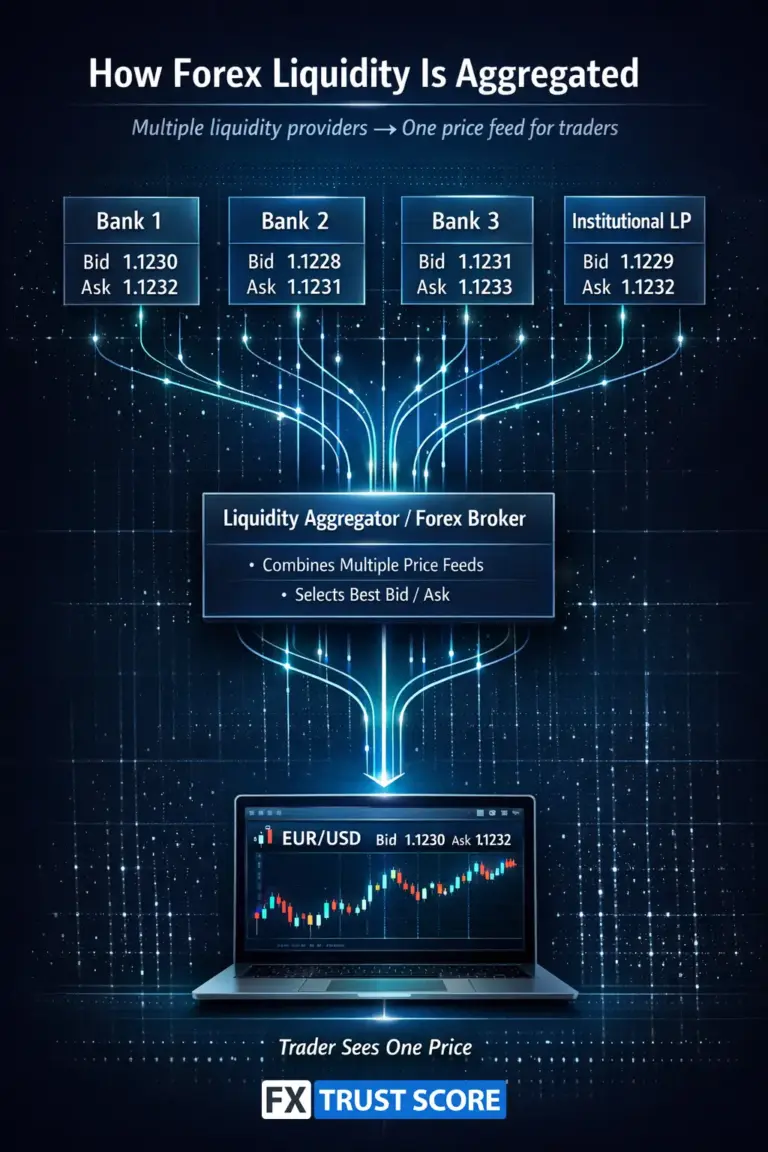
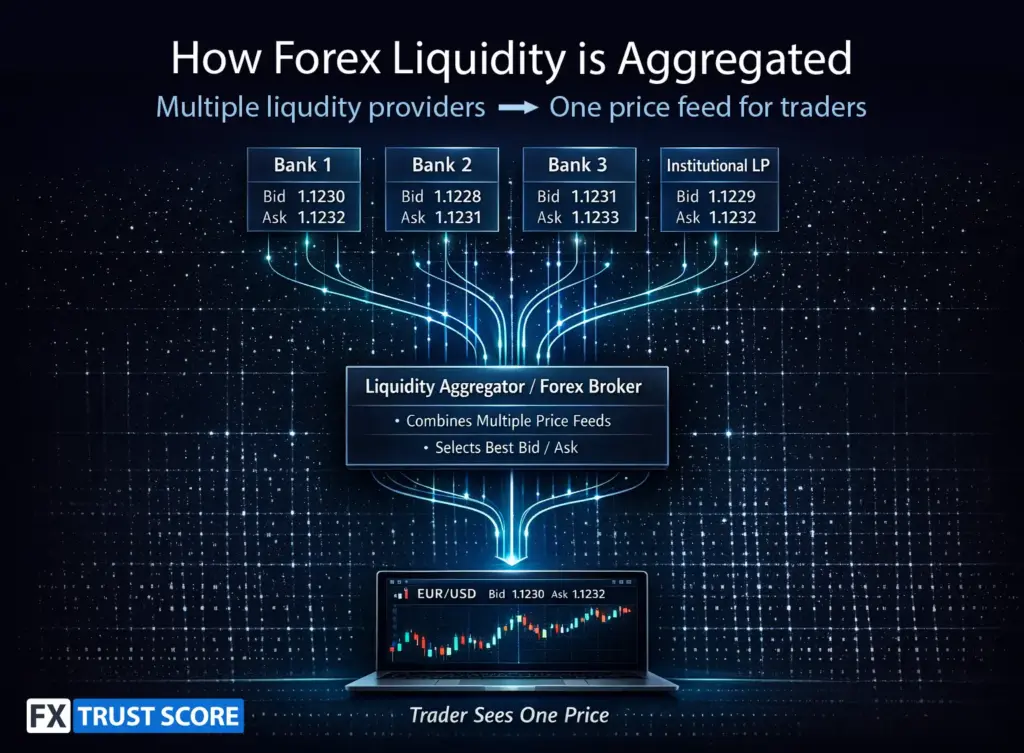
Most brokers connect to multiple liquidity providers simultaneously. Their trading systems aggregate quotes from different sources and select the best available bid and ask prices.
This process is known as liquidity aggregation.
By combining quotes from several providers, brokers can offer:
- tighter spreads
- greater market depth
- more reliable execution during volatile market conditions
The aggregated price feed is what traders ultimately see on platforms such as MetaTrader 4 or MetaTrader 5.
Liquidity Providers and Market Volatility
Liquidity conditions can change depending on market events. During periods of high volatility, such as major economic announcements, liquidity providers may widen spreads or reduce quoted volumes. This is one reason spreads often increase during important news releases.
When liquidity decreases, brokers may need to source prices from fewer providers or adjust spreads to reflect the underlying market conditions.
Why Liquidity Providers Matter for Traders
While retail traders rarely interact directly with liquidity providers, these institutions play an important role in the trading experience.
The quality and diversity of a broker’s liquidity relationships can influence:
- spread competitiveness
- execution reliability
- slippage behaviour
- market stability during volatile conditions
For traders evaluating brokers, understanding how liquidity providers operate provides useful context when comparing trading environments.
Related Guides
FAQs
A liquidity provider is a financial institution that continuously offers buy and sell prices for currency pairs, allowing brokers and traders to execute trades efficiently.
Liquidity providers are usually large banks, institutional trading firms and market-making companies that supply prices to brokers and trading venues.
Forex brokers typically access liquidity through prime brokers or liquidity aggregators that combine price feeds from multiple institutions.
Higher liquidity usually leads to tighter spreads and faster execution, while lower liquidity during volatile market conditions can cause spreads to widen.
Publication date:
20/04/2026
Author: FX Trust Score
Last updated on April 20, 2026