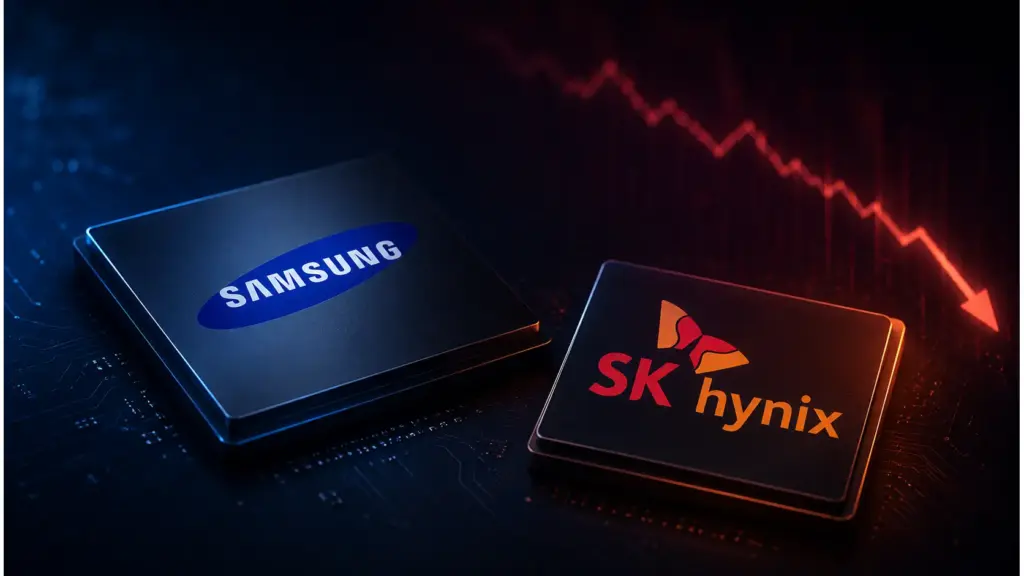
South Korea’s chip-led stock rally has turned sharply lower, with SK Hynix and Samsung caught in a sell-off driven by high AI expectations, leverage and semiconductor earnings pressure.

South Korea’s chip-led stock rally has turned sharply lower, showing how quickly the AI trade can reverse when high expectations, leverage and semiconductor earnings collide.
South Korea’s stock market is still under pressure after a historic chip-led sell-off, even after Samsung Electronics reported a sharp recovery in semiconductor profit and warned that global chip shortages could extend into 2028.
The KOSPI fell heavily on Wednesday, 29 July 2026, after already suffering a sharp decline on the previous day. At one stage, the move wiped as much as $2.18 trillion from Seoul’s equity market, with SK Hynix and Samsung at the centre of the reversal as the rally in artificial-intelligence-linked shares gave way to forced selling, profit-taking and fresh concern over crowded positions.
The sell-off has been striking because it came despite strong numbers from the companies at the centre of the trade. SK Hynix reported a sharp jump in quarterly profit, but the result missed the market’s high expectations. Samsung then reported a major recovery in chip profit on Thursday, 30 July 2026, and said memory-chip shortages could become more acute, yet the update was not enough to remove concern over valuation, leverage and the cost of the wider AI build-out.
SK Hynix and Samsung lead the pressure
SK Hynix has become one of the most important listed companies in the AI supply chain because of its role in high-bandwidth memory, the advanced memory used alongside powerful AI processors. That position helped turn the stock into one of Asia’s most closely watched technology trades this year, as demand for AI infrastructure lifted expectations for memory-chip suppliers.
The problem is that expectations became difficult to satisfy. SK Hynix delivered a strong rise in quarterly profit, but the market had already priced in an exceptional result. When the numbers fell short of forecasts, the reaction was severe, with the stock sliding and the wider South Korean market following.
Samsung has faced a slightly different version of the same issue. Its semiconductor business has staged a powerful recovery, helped by rising memory prices and demand from data-centre customers. The company also said global chip shortages could extend into 2028, which would normally be supportive for a major memory-chip maker. Even so, the market reaction remained cautious, showing that strong demand headlines are no longer enough on their own.
The message from both companies is clear. In the current AI trade, good results can still disappoint if expectations have already moved too far ahead.
AI expectations become harder to satisfy
The South Korean sell-off shows how the AI story has entered a more demanding phase. Earlier in the year, semiconductor shares benefited from a simple market narrative: AI spending was rising, cloud companies needed more chips, and memory suppliers stood to gain from shortages in advanced components. That story still matters, but the market is now asking a harder question: can profits keep growing fast enough to justify the valuations reached during the rally?
AI-linked shares are no longer trading only on current earnings. They are also trading on future demand from data centres, cloud platforms, model developers and hardware suppliers. When those future assumptions are high, even record or near-record profit growth can be punished if it does not beat expectations convincingly.
FX Trust Score recently examined why markets are becoming less forgiving of AI spending plans, and South Korea’s rout is another example of that shift. The issue is not whether AI demand exists. It is whether the spending boom can continue supporting every part of the supply chain at prices the market has already accepted.
Leverage makes the fall sharper
The speed of the decline has also drawn attention to leveraged trading products. South Korea introduced single-stock leveraged exchange-traded funds linked to companies including Samsung Electronics and SK Hynix earlier this year. These products allowed retail traders to gain amplified exposure to daily moves in major chip shares, adding fuel to the rally as enthusiasm for the AI trade gathered momentum.
The same structure can add pressure when the market turns. Leveraged products often require rebalancing, while traders using borrowed money can be forced to close positions when losses build quickly. A rally helped by leverage can therefore become more unstable when the direction changes.
South Korean regulators had already moved to tighten rules around these products, including higher deposit requirements for retail traders and restrictions on new listings. After this week’s market turbulence, the issue has become even more important because authorities are trying to limit the effect of speculative flows on major shares.
That is where the story becomes especially relevant for the FX Trust Score audience. This is not only a semiconductor earnings story. It is also a reminder that easy access to high-risk trading products can magnify market moves when popular themes become crowded.
The sell-off spreads beyond Seoul
South Korea’s rout has not stayed isolated. The country’s two largest chip names are deeply connected to the global technology trade. SK Hynix supplies advanced memory used in AI systems, while Samsung is a major force in memory chips, smartphones, displays and foundry manufacturing. When both names come under pressure, traders quickly look at other companies exposed to the same cycle.
This includes Nvidia and AMD in the United States, TSMC in Taiwan, Micron in memory chips and Japanese semiconductor-equipment names. The reaction across these stocks is important because AI has turned the semiconductor sector into a global chain of linked expectations. A change in sentiment in Seoul can affect Taiwan, Tokyo and Wall Street within the same trading cycle.
FX Trust Score has also reported how Nvidia has become a wider signal for global risk appetite, and South Korea’s sell-off shows the other side of that influence. When the AI trade is working, the supply chain can move together. When confidence weakens, the same links can spread pressure quickly across regions.
Samsung’s warning cuts both ways
Samsung’s warning that chip shortages may extend into 2028 cuts both ways. For memory suppliers, tight supply can support prices and margins. Long-term supply agreements with data-centre customers also suggest that demand remains strong from major technology groups building AI infrastructure. Those points support the argument that AI-related chip demand is not disappearing.
At the same time, shortages and higher chip prices can create pressure elsewhere. Samsung’s mobile business is exposed to rising component costs, while cloud companies and AI developers face higher infrastructure bills. A shortage that helps one part of the technology sector can therefore squeeze another.
This is why the market reaction has been uneven. The AI supply chain is not a single clean story of rising demand and rising profits. It is a more complicated cycle in which data-centre customers, chipmakers, device manufacturers and retail traders are all exposed to different parts of the same pressure.
Why this matters for traders
The South Korea rout matters because it challenges the idea that AI-linked shares can keep rising simply because demand remains strong.
A company can be central to the AI supply chain and still fall sharply if the market has already priced in too much good news. A sector can report strong profits and still suffer if leverage, valuation and expectations become too stretched. That is the lesson from SK Hynix and Samsung this week.
The case is especially important for retail traders because popular themes can look safest just before they become crowded. When a large number of traders are exposed to the same story through shares, ETFs, leveraged products and options, a weaker-than-expected result or cautious market reaction can trigger a much larger move than the earnings numbers alone might suggest.
The South Korean example also shows why market structure matters. The products traders use, the amount of leverage in the system and the concentration of a market in a small number of large stocks can all affect how quickly a sell-off develops.
What comes next
The next question is whether South Korea’s sell-off remains a local market event or becomes a broader warning for the global AI trade.
Traders will be watching whether SK Hynix and Samsung stabilise, whether South Korean regulators announce further measures on leveraged products, and whether foreign investors continue to reduce exposure to the KOSPI. The reaction in Nvidia, AMD, Micron, TSMC and Japanese chip names will also show whether the pressure is spreading through the global semiconductor chain.
The wider earnings season remains important as well. Major technology companies are still reporting, and their comments on AI spending, data-centre demand and cloud infrastructure will influence how the market judges the next stage of the cycle.
South Korea has provided a sharp reminder that the AI trade is no longer moving in a straight line. SK Hynix and Samsung remain central to the semiconductor boom, but this week’s market reaction shows that even the strongest companies can come under pressure when expectations, leverage and volatility rise together.