SK Hynix has moved ahead of Samsung in market value, showing how AI demand is shifting investor attention from processors to the memory technology behind them.

The South Korean chipmaker’s rise shows how AI demand is shifting attention from processors to the memory technology behind them
SK Hynix has moved ahead of Samsung Electronics in market value, marking a symbolic moment for South Korea’s technology sector and the wider AI trade.
This represents a major shift in how traders and investors are looking at the semiconductor market. For much of the AI rally, attention has focused heavily on advanced processors and the companies that design or supply them. However, the rise of SK Hynix shows that memory chips are now becoming central to the next phase of the AI investment story.
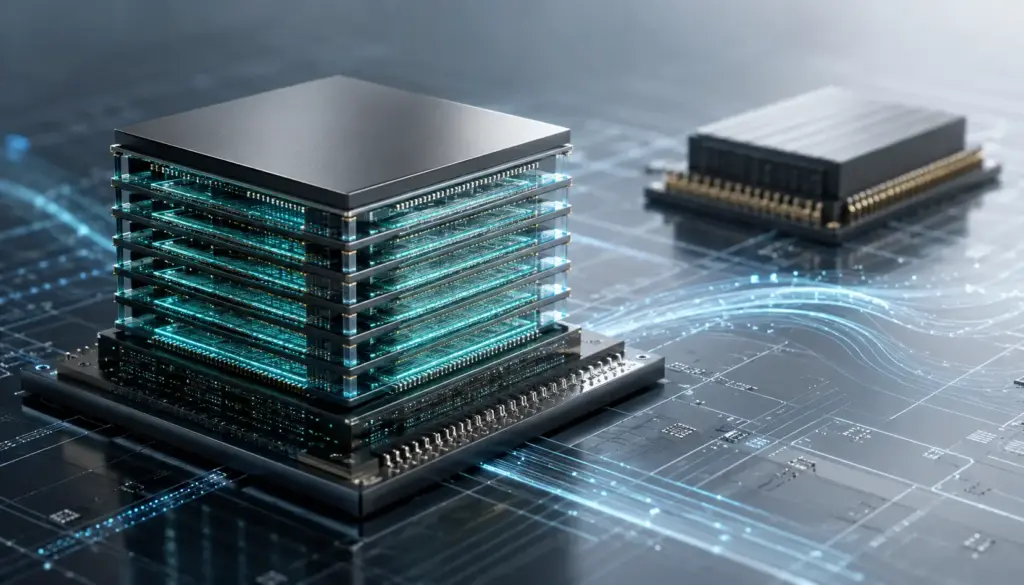
The company has benefited from strong demand for high-bandwidth memory, known as HBM, which is used in advanced AI systems and data centres. As artificial intelligence workloads become larger and more complex, demand is no longer limited to processors. AI systems also require memory technology capable of moving large amounts of data quickly and efficiently. This is helping SK Hynix challenge Samsung’s long-standing dominance in South Korean markets.
A symbolic market shift in South Korea
Samsung has long been the dominant name in South Korean equities. Its scale, brand recognition and semiconductor business have made it one of Asia’s most closely watched companies for global investors.
SK Hynix moving ahead of Samsung therefore carries more meaning than a normal daily market move. It signals that traders are placing greater value on companies positioned directly inside the AI infrastructure supply chain.
For South Korea, the shift also highlights how quickly market leadership can change when a new technology cycle accelerates. Samsung remains a major semiconductor and technology company, but SK Hynix has gained momentum because investors see it as one of the clearest beneficiaries of AI memory demand.
The question for traders is whether this is a temporary market milestone or evidence of a more durable shift in semiconductor leadership.
Why AI memory matters
Artificial intelligence systems depend on more than powerful processors.
Large AI models need chips that can process data quickly, but they also need memory capable of supporting that processing. High-bandwidth memory is designed to help move data at high speed while using less power than traditional memory configurations.
This makes HBM especially important for AI data centres, where performance, efficiency and scale all matter. As companies continue investing in AI infrastructure, memory suppliers are becoming more important to the overall technology trade.
This is also why SK Hynix’s rise matters for traders. It suggests that the AI trade is becoming broader and more sophisticated. Investors are not only looking at the most obvious AI names. They are also looking deeper into the supply chain to identify the companies that provide critical infrastructure behind the AI boom.
Traders are looking beyond Nvidia
Nvidia remains the best-known name in the AI chip story, and its performance continues to influence sentiment across global markets.
However, the rise of SK Hynix shows that the AI trade is no longer only about processors. Memory chips, chip packaging, data-centre components and the companies that supply the infrastructure needed to make AI systems work at scale, are becoming increasingly important.
It does not mean that every AI-related stock will keep rising, however, it means that the market is becoming more selective about where AI demand is creating real revenue growth, pricing power and supply constraints.
This is why Nvidia’s influence on global markets continues to grow remains relevant, but it is no longer the entire story. The companies supporting Nvidia and other AI leaders are becoming important market movers in their own right.
Samsung faces a more competitive AI memory race
Samsung is still one of the most important semiconductor companies in the world, but the AI memory cycle has made the competitive landscape more difficult.
SK Hynix has been seen as a leader in high-bandwidth memory, while Samsung has faced pressure to prove it can close the gap in this part of the market. That matters because HBM is not a simple commodity memory product. It is closely tied to advanced AI processors and data-centre demand.
For traders, this creates a clear comparison. Samsung remains large and diversified, but SK Hynix has become closely associated with one of the strongest areas of AI-related demand. The market is rewarding that focus.
Asian chip stocks remain important for global traders
The SK Hynix story also reinforces the importance of Asian semiconductor markets. AI demand is global, but much of the supply chain runs through Asia. South Korea, Taiwan and Japan all play important roles in chips, memory, equipment, manufacturing and advanced technology components.
This means movements in Asian chip stocks can influence sentiment far beyond local markets. When semiconductor names in Asia rise, they can support confidence in the broader AI trade. When they weaken, they can quickly raise questions about whether AI expectations have become too stretched.
This is one reason Asian chip stocks gain momentum as AI demand accelerates has become an increasingly important theme for traders watching global technology markets.
The opportunity angle comes with risk
SK Hynix’s rise will naturally prompt traders and investors to ask whether the AI memory trade still has room to grow.
That is a fair question. AI infrastructure spending remains strong, demand for advanced memory has increased and supply constraints can support pricing power when demand outpaces available capacity.
However, traders also need to consider the risks. SK Hynix has already rallied strongly, and expectations around AI demand are high. If supply improves, pricing pressure returns or AI spending slows, the same stocks that benefited most from the rally could also become more vulnerable to profit-taking.
The investment case is therefore not simply about whether AI demand exists. It is about whether current valuations already reflect much of that demand, and whether future earnings can continue to justify investor enthusiasm.
A broader AI trade is taking shape
The biggest message from SK Hynix overtaking Samsung is that the AI trade is broadening.
Processors remain important, but memory has become one of the key areas traders are now watching. The companies that support AI data centres, cloud infrastructure and advanced computing are increasingly being treated as central players rather than secondary beneficiaries.
That is why the story matters beyond South Korea. For traders, SK Hynix’s rise is a reminder that market leadership can shift quickly when technology demand changes. The next stage of the AI trade may not only be about the companies building the most visible products, but also about the suppliers providing the technology that makes those products possible. SK Hynix has become one of the clearest examples of that shift.