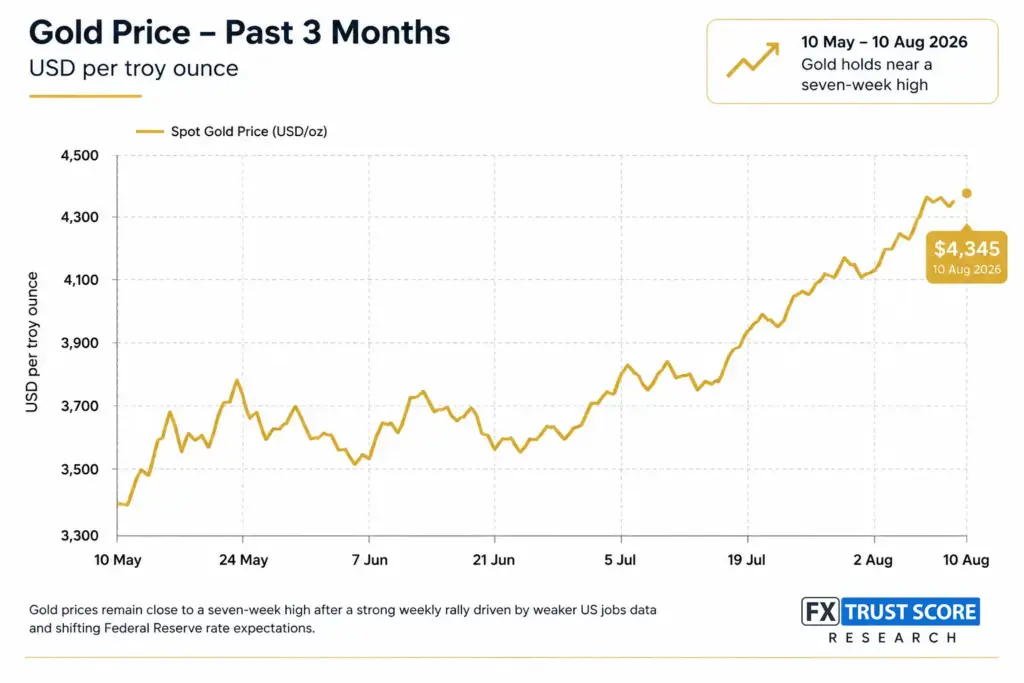
Gold is holding close to a seven-week high after weak US employment data reduced expectations for another Federal Reserve rate rise. Attention now turns to Wednesday’s US inflation report for the next major signal.

Gold is holding close to a seven-week high after weak US employment data triggered a sharp reassessment of Federal Reserve interest-rate expectations, leaving Wednesday’s inflation report as the next major test for bullion.

Gold retains gains after strong weekly rally
Gold prices remained elevated on Monday after a powerful rally at the end of last week pushed the precious metal to its highest level since mid-June. Spot gold was trading at around $4,345 an ounce during the European session, whilst US gold futures were near $4,405. The metal gained more than 7% over the previous week, which is its strongest weekly performance since January.
Friday produced the decisive move. Gold rose sharply after the latest US employment report showed that the economy unexpectedly lost jobs in July, challenging expectations that the Federal Reserve could raise interest rates again as early as September.
The move extends a volatile period for bullion. FXTrustScore previously reported how gold hit a two-week high after an oil rally revived inflation fears, when energy prices and the Middle East conflict were placing renewed pressure on the inflation outlook. This time, however, the immediate catalyst has shifted from energy towards the strength of the US labour market and what that means for monetary policy.
Weak US jobs report changes the rate equation
US nonfarm payroll employment fell by 23,000 in July, while economists had positively expected an increase. More importantly for financial markets, employment figures for May and June were revised down by a combined 103,000 jobs.
The unemployment rate stood at 4.1%, but the labour force participation rate remained subdued at 61.4%. These figures complicated the Federal Reserve’s policy outlook. At its latest meeting on 29 July, the Fed left its benchmark interest-rate range unchanged at 3.5% to 3.75%. Three policymakers voted for a quarter-point increase, underlining the extent to which inflation remained a concern before the weaker employment figures were released.
Markets have since reduced the probability of a September rate increase to around 44%, compared with 57% before Friday’s employment report and approximately 67% a week ago.
This change is important in the context of gold because the metal does not generate interest. When expectations for higher rates decline, the relative opportunity cost of holding bullion also falls.
Dollar weakness provides additional support for gold
The shift in rate expectations has also weighed on the US dollar. The dollar index was trading near 99.6 on Monday after reaching its lowest level since mid-June on Friday. Meanwhile, the euro, remained close to its strongest level against the dollar since June.
Due to the fact that gold is priced internationally in US dollars, a weaker dollar can essentially make the metal less expensive for buyers using other currencies and can provide additional support to demand.
Gold’s latest move therefore reflects two closely related developments: falling expectations for additional US monetary tightening and a softer dollar. The relationship has been a recurring feature of gold markets this year. In June, FXTrustScore examined how gold faced a new test as inflation and rate expectations collided, and the same forces are again shaping short-term price direction. The difference now is that the labour market has added another source of uncertainty to the Federal Reserve’s calculations.
Wednesday’s inflation report becomes the next major test
Attention now turns to the US Consumer Price Index report due on Wednesday, 12 August. Economists expect headline inflation to have eased slightly to 3.4% year-on-year in July from 3.5% in June. Core inflation, which excludes food and energy, is expected to rise by 0.2% month-on-month, with the annual rate moderating to 2.5% from 2.6%. The result could have an outsized influence on gold because markets have already reacted strongly to the deterioration in employment data.
A softer-than-expected inflation reading could reinforce expectations that the Federal Reserve has less need to raise rates again in September. That could place additional pressure on the dollar and preserve the conditions that have supported gold’s recent rally.
A stronger inflation reading would create a more complicated picture. Persistent price pressures could revive expectations for further monetary tightening even as employment growth weakens, potentially increasing volatility across gold, currencies and bond markets.
The Federal Reserve itself has said inflation remains elevated relative to its 2% target, with energy-related supply shocks contributing to recent price pressures.
Oil and the Middle East remain part of the inflation backdrop
Gold’s immediate focus may have shifted towards interest rates, but developments in the Middle East have not disappeared from the picture. Brent crude remains elevated as markets continue to assess negotiations over shipping through the Strait of Hormuz. Higher energy costs can feed into inflation expectations, potentially affecting the policy decisions that ultimately influence both the dollar and gold, which in turn creates a difficult balance for markets.
Weakening employment argues against aggressive monetary tightening, while persistently high inflation could still prevent the Federal Reserve from becoming significantly more accommodative.
Gold is currently benefiting from the first part of that equation. Wednesday’s inflation figures will provide an important indication of whether the second part begins to push back.
Gold traders turn attention to the next inflation signal
After last week’s strong rally, gold begins the new week close to its highest level in almost two months rather than extending the move aggressively, which suggests that the market is now waiting for the next major piece of information.
Wednesday’s CPI report, followed by US producer-price data on Thursday, should provide further evidence on whether inflation is continuing to moderate and whether the Federal Reserve’s next move is becoming less likely to involve another rate increase.
For gold, the combination of weaker employment growth, reduced rate-hike expectations and a softer dollar has created a supportive short-term backdrop. Whether this remains intact may depend heavily on what the next inflation figures reveal.