The Bank of England has warned that AI enthusiasm, leverage, stretched valuations and cyber risk could create sharper market volatility if investor expectations change.

The central bank has linked AI enthusiasm to stretched valuations, leverage, cyber risk and crowded market positioning, giving traders a fresh reason to look beyond the headline tech rally
The Bank of England has placed artificial intelligence more firmly inside the financial-stability debate, warning that the AI investment boom could create sharper market risks, if investor expectations change.
The warning is important because AI is no longer just a technology story. It has essentially become one of the biggest forces behind equity-market performance, semiconductor demand, index concentration and risk appetite. For traders and investors, this means the AI trade now carries a wider set of questions around valuation, leverage, debt and market structure.
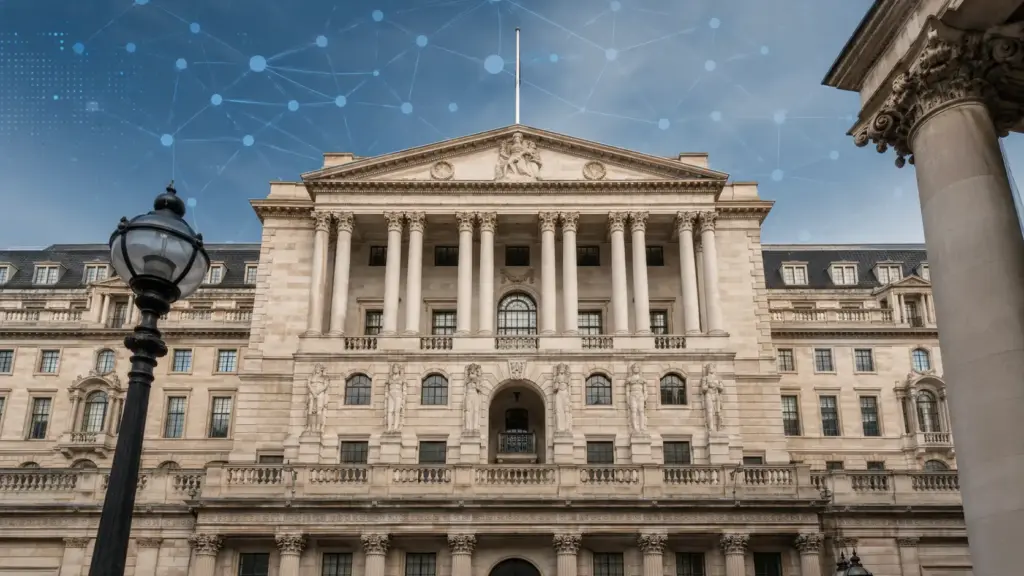
Reuters reported that the Bank of England has flagged growing risks from AI in its latest financial-stability assessment, including stretched share prices, hedge-fund borrowing, AI-related corporate debt and cybersecurity threats to banks and financial firms.
The central bank did not say however, that the AI rally is about to collapse. Its warning is more specific. If investors reassess how profitable AI will become, the fall in equity prices could be amplified by concentrated positions, momentum-driven trading and higher leverage. This is the part traders should pay attention to.
AI moves from growth story to market risk
For much of the past year, AI has been treated mainly as a growth theme. Investors have focused on chip demand, cloud infrastructure, data centres, software productivity and the companies most likely to benefit from large-scale AI adoption.
This story has helped drive major moves in technology stocks and equity indices. However, the Bank of England’s warning shows that regulators are now looking at the other side of the trade. When too much market confidence is built around one theme, the risk is not only that valuations become expensive. The larger concern is that many investors, funds and trading strategies may be positioned in similar ways. If the story weakens, those positions can unwind quickly. AI is increasingly becoming a market-structure issue, not only a stock-market narrative.
Why stretched valuations matter for traders
High valuations do not automatically mean a market is due for a sell-off. Strong companies can remain expensive for long periods, especially when earnings growth is powerful and investor demand remains strong. The risk comes when valuations depend on very high expectations. In the case of AI, investors are not only pricing current profits. They are also pricing future productivity gains, future infrastructure demand and future revenue growth across a large part of the technology sector.
If those expectations are revised lower, the impact may not be limited to one company or one earnings report. It could affect chipmakers, cloud providers, software firms, data-centre suppliers, power infrastructure stocks and the wider indices where large AI-linked companies carry heavy weight.
For traders using CFDs or leveraged products, that matters because a sharp move in a crowded sector can quickly affect margin, stop-loss levels and execution conditions.
Leverage could deepen an AI sell-off
The Bank of England also pointed to leverage as part of the risk. This is important because leverage can turn a normal market correction into a faster and more disorderly move. If hedge funds or other investors have borrowed to increase exposure to AI-related stocks, falling prices can force position reductions. Selling can then add more pressure to the same market areas already under stress.
This is how crowded trades become unstable. The issue is not simply whether investors are right or wrong about AI over the long term. The issue is whether the short-term market structure can absorb a sudden change in sentiment. For retail traders, the lesson is practical. A popular trade can still be risky if too many participants are positioned in the same direction.
AI-related debt adds another layer
The AI boom is also capital intensive. Data centres, chips, cloud capacity and energy infrastructure require huge spending. Some companies can fund that investment comfortably. Others may rely more heavily on borrowing or external financing.
The Bank of England noted that the sustainability of AI-related corporate debt depends on profitable adoption, infrastructure delivery and continued access to finance, which adds another layer to the risk picture.
If AI revenue growth disappoints, companies with weaker balance sheets could face pressure. If financing conditions tighten, highly ambitious AI infrastructure plans may become harder to support, which could consequently affect both equity valuations and credit markets.
For investors, this means the AI story should not be judged only by product announcements or headline demand. Balance sheets, cash flow and funding conditions are also important aspects to consider.
Cyber risk enters the financial-system debate
The Bank of England’s warning was not limited to valuations. It also highlighted cyber and operational risks from AI. Financial firms are increasingly exposed to complex technology systems, software updates, third-party providers and automated processes. AI may improve defence and efficiency, but it can also increase the speed, scale and sophistication of attacks.
This is relevant for traders because financial markets depend on trust in infrastructure. Banks, brokers, exchanges, payment systems and custody providers all rely on secure and resilient technology. If AI creates new operational weak points, the risk is not only theoretical. A cyber incident or technology failure can affect access, pricing, liquidity and the ability of clients to manage positions during volatile conditions.
AI tools and financial advice raise another concern
A separate UK regulator-commissioned review has also raised concerns about consumers using large language models for financial guidance. Reuters reported that more than a quarter of UK consumers trust tools such as ChatGPT, Claude and Gemini for financial advice, even though users may not understand that normal financial-service protections do not apply to those tools.
This is another important part of the AI risk story. AI is influencing markets from two directions. It is shaping investor enthusiasm for listed companies, and it is also becoming part of how some people research, interpret and act on financial information.
This creates a difficult boundary. Generic information is not the same as regulated financial advice. However, the difference may not always feel clear to users, when a chatbot gives confident, personalised-sounding answers.
For traders, it makes source quality and verification more important. AI can be useful for research, but it should not replace proper due diligence, platform checks or risk management.
What traders should watch next
The AI trade is not disappearing. The technology may continue to reshape business models, infrastructure spending and long-term investment themes. But the Bank of England’s warning is a reminder that strong narratives can still carry hidden risks.
Traders should watch whether AI-linked stocks remain highly concentrated inside major indices, whether earnings expectations keep rising, whether leveraged exposure builds further and whether credit conditions stay supportive for AI infrastructure spending.
They should also pay attention to market behaviour around major AI earnings reports. If strong results fail to lift related stocks, or if record profits are met with selling, that may suggest investors are becoming more selective.
The key point is not that AI is overhyped or that the rally must reverse. The more useful point is that AI has become large enough to matter for financial stability. For traders and investors, it is no longer only which companies may win from AI, but also how much risk is now sitting inside the trade, how crowded the positioning has become and whether the market can handle a sudden shift in expectations.