Copper has reached a fresh record above $14,500 a tonne as AI infrastructure, grid investment and tightening supply drive renewed investor interest in the industrial metal.

Copper has climbed to a fresh record above $14,500 a tonne, driven by tightening supply, falling inventories outside the United States and relentless demand from power grids, data centres, electric vehicles and advanced manufacturing. Copper is increasingly being treated as a strategic asset at the centre of the global electrification and AI build-out.
Copper enters record territory
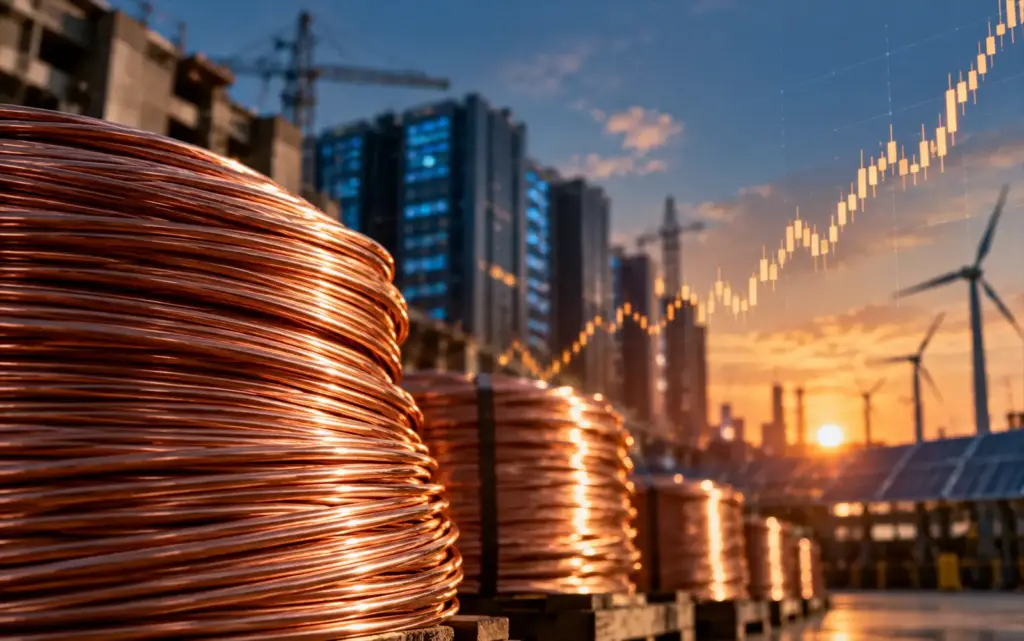
Copper rose to a record of around $14,533 a tonne on the London Metal Exchange, surpassing the previous peak set earlier this year. It had already experienced strong gains in 2026, supported by a combination of supply concerns, infrastructure investment and growing demand from industries that heavily depend heavily electrification.
The scale of the movement shows that copper occupies a unique position in the global economy. It is used extensively in electricity transmission, renewable energy systems, electric vehicles, industrial machinery and construction. More recently, the rapid expansion of AI data centres has added yet another powerful source of demand because large-scale computing facilities require enormous amounts of electrical infrastructure, cooling systems and grid connections.
The old assumption that copper demand would be driven mainly by construction and traditional industrial cycles is shifting and now the metal is increasingly tied to several of the largest long-term investment themes in financial markets.
The AI boom is creating a new layer of copper demand
Artificial intelligence is often discussed through the companies designing chips or building data centres, but the underlying infrastructure of those systems is equally important. Every new data centre requires power and it has to be generated, transmitted and distributed through physical infrastructure, much of which depends on copper. Transformers, cables, switchgear and cooling systems all increase the amount of metal required as computing capacity expands.
Consequently, this is why the AI investment cycle is beginning to influence commodity markets as well as technology stocks, particularly as AI infrastructure spending places greater pressure on power grids and physical capacity.
The demand does not come only from the data centres themselves. Governments and utilities are also being forced to strengthen electricity grids as AI, electric vehicles and electrified heating place greater pressure on power systems. In countries such as South Korea, where semiconductor production and data-centre construction are accelerating, projected electricity demand is rising sharply enough to reopen debates over nuclear capacity and long-term energy planning. Copper therefore sits at an unusual intersection between technology, energy and infrastructure.
Supply is struggling to keep pace
In terms of supply, global mine production has been under pressure, with output disruptions and weaker production in several major copper-producing countries adding to concerns about how quickly new supply can enter the market. It takes years to develop copper mines and large projects often face permitting delays, environmental opposition, financing difficulties and infrastructure constraints, which creates a structural problem; demand can rise quickly when investment accelerates, but supply cannot respond at the same speed.
The imbalance between supply and demand is one reason the market has become increasingly sensitive to relatively small changes in inventories or production forecasts. When available stocks fall, prices can move sharply because buyers have fewer immediate alternatives. The current rally is therefore not simply speculative enthusiasm. It reflects a market in which the margin for error is narrowing.
Inventories are becoming increasingly uneven
One of the more interesting features of the copper market is that the apparent global supply position can look healthier than the regional picture suggests. Refined copper production remains relatively comfortable overall, but inventories are not distributed evenly. Stocks outside the United States have been falling, whilst American warehouses have been receiving unusually large inflows as traders position for possible changes in tariff policy. Consequently, it has created a geographic distortion.
London Metal Exchange inventories have declined significantly, while Shanghai stocks have also fallen. In parallel, copper has been flowing into the United States, where traders have been building inventories ahead of potential new tariffs on refined metal.
The result is a market where headline global supply figures can appear less alarming than the actual availability of copper in particular regions.
For traders, that matters because local scarcity can still push benchmark prices higher even if the world as a whole is not technically running out of refined copper.
Tariffs are adding another layer of uncertainty
The prospect of further US tariffs on refined copper has encouraged importers to bring more metal into the country, effectively pulling supply away from other regions. That has contributed to tighter inventories elsewhere and reinforced the upward pressure on prices. It is another example of how copper is becoming increasingly geopolitical.
Governments now view critical minerals as part of national industrial strategy. Copper sits alongside lithium, cobalt, rare earths and semiconductors in a broader competition to secure the materials required for electrification, defence, digital infrastructure and advanced manufacturing. This means that in the future, copper prices may be influenced as much by industrial policy and trade restrictions as by traditional mining fundamentals.
Why copper matters to investors
For investors, copper is attractive because it offers exposure to several structural themes at once. The first is electrification. Electricity grids require significant amounts of copper and many countries are investing heavily in transmission infrastructure after years of underinvestment.
The second is the energy transition. Electric vehicles typically use more copper than internal-combustion vehicles, while renewable energy systems require extensive wiring and grid connections.
The third is artificial intelligence. Data centres need large amounts of power and supporting infrastructure, making copper an indirect beneficiary of the global race to build computing capacity.
The fourth is supply scarcity. New mines are difficult and expensive to develop, meaning a significant rise in demand cannot be matched quickly.
Copper is also part of a broader return of commodities to the centre of market attention, with rising energy and raw-material costs influencing inflation, yields and investor positioning.
The combination of structural themes explains why some investors are beginning to view copper as a strategic long-term asset.
Record prices do not remove the risks
A record high does not necessarily mean that copper can only move in one direction. The metal remains highly sensitive to the global economic cycle, particularly activity in China, which is one of the world’s largest consumers of copper. A meaningful slowdown in Chinese construction, manufacturing or investment could reduce demand and place pressure on prices. Higher prices can also eventually destroy demand.
Manufacturers may redesign products to use less copper, switch to alternative materials where possible or delay investment if costs become too high. Recycling also becomes more attractive when prices rise, bringing additional supply back into the market. There is therefore a difference between a strong long-term demand story and a guarantee of continually rising prices.
For traders, the question is whether the current rally is being driven by a genuine structural shortage or whether some of the move reflects temporary inventory distortions and speculative positioning.
How investors can gain exposure to copper
Investors who want exposure to copper have several options, each with different characteristics and risks.
One route is through copper futures, which provide direct exposure to the price of the metal but are generally more suitable for experienced traders because contracts involve leverage, expiry dates and margin requirements.
Another option is through exchange-traded products linked to copper prices or copper-mining companies. These can provide simpler access through a conventional investment account, although performance may differ from the underlying commodity depending on the product structure.
Mining shares offer another form of exposure. Companies producing copper can benefit when prices rise, but their share prices are also affected by operating costs, political risk, mine quality, debt and management decisions. A copper miner is therefore not the same investment as copper itself.
Some multi-asset brokers also offer copper CFDs, which allow traders to speculate on price movements without owning the underlying commodity. These products use leverage and can amplify both gains and losses, so they are fundamentally different from buying an unleveraged investment.
The right approach depends on whether the investor is seeking long-term exposure, short-term speculation or diversification.
What traders should watch next
The immediate focus will remain on inventories, mine output and signs that demand from data centres and power-grid investment is continuing to accelerate.
China will remain particularly important because its industrial activity can have a significant influence on the global copper market. Stronger manufacturing and export demand would support consumption, while weaker domestic investment could act as a counterweight.
Investors should also watch tariff policy and the movement of copper between major trading hubs. If stocks continue to build in the United States while falling elsewhere, regional shortages could keep benchmark prices elevated even without a clear global deficit.
AI, electrification and grid investment are creating new sources of demand at a time when mining supply remains slow to expand. That does not mean copper will rise indefinitely, but it does mean the market is being reshaped by forces that extend far beyond the traditional commodity cycle.
For investors, the significance of copper’s latest record may therefore lie less in the price itself and more in what it reveals about the growing competition for the physical materials needed to power the next phase of global technology and infrastructure investment.