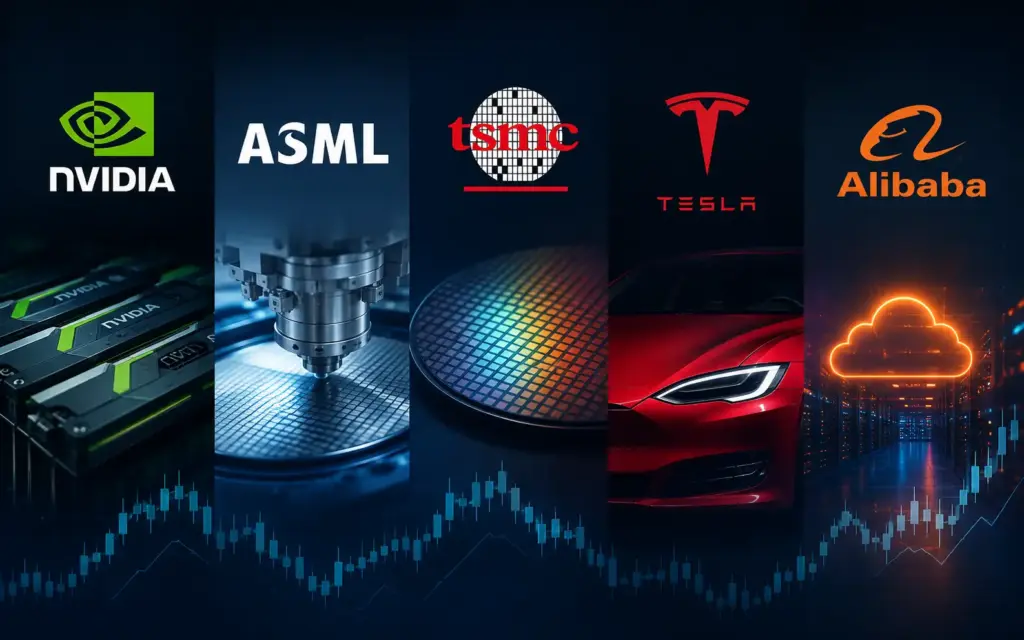
Nvidia, ASML, TSMC, Tesla and Alibaba are among the stocks in focus as traders assess AI growth, valuations, higher bond yields and geopolitical risk. Here is what is driving each stock and what investors should watch next.

Technology remains at the centre of global markets as investors assess five major stocks with very different drivers. Nvidia, ASML, TSMC, Tesla and Alibaba are all in focus as AI spending, semiconductor demand, electric vehicles and China’s technology push shape the next phase of the trade.
The broad technology rally has created substantial gains across parts of the market, however increasingly demanding valuations mean that strong results are no longer substantial enough on their own. Investors are also looking more closely at whether companies can maintain growth, protect profit margins and justify the enormous amounts of capital being committed to artificial intelligence, advanced manufacturing and next-generation infrastructure.
The five companies below are all exposed to major structural themes, but they are exposed in very different ways, which means their next moves are likely to be shaped by a different combination of earnings, valuation, capital expenditure, regulation and geopolitical risk.
Nvidia: AI demand remains stronger than many expected
Nvidia continues to sit at the centre of the global AI investment cycle after another set of results that exceeded market expectations. Quarterly revenue more than doubled to approximately $96.2 billion, and it projected revenue growth of approximately 70% for its next financial year, which is significantly stronger than analysts had anticipated.
The strength of this outlook somewhat reassured investors who had begun to question whether years of extraordinary spending on artificial intelligence infrastructure could possibly continue at the same pace. Demand remains broad, with large cloud providers still accounting for a significant share of purchases whilst AI laboratories, enterprises, governments and specialist cloud operators are also increasing their use of high-performance computing systems.
Nvidia’s next-generation Vera Rubin platform is expected to become an increasingly important part of its data-centre business, but the biggest challenge is moving from demand towards supply. Memory shortages and higher component costs are limiting how quickly Nvidia can meet orders and are expected to place some pressure on gross margins later in the year.
This creates an unusual investment profile. Nvidia is still delivering exceptional growth, but its valuation already assumes a high degree of future success, leaving the shares sensitive to even relatively small changes in margins, guidance or capital-spending expectations.
China remains another source of uncertainty. Access to the Chinese market continues to be complicated by semiconductor export restrictions, and Nvidia excluded China data-centre revenue from its latest outlook, meaning any regulatory change could quickly alter investor assumptions about future growth.
What traders should watch: Nvidia’s ability to maintain margins whilst scaling Vera Rubin production, the durability of hyperscaler AI spending and any further changes to semiconductor export rules affecting China.
ASML: Europe’s most important AI infrastructure stock
ASML offers a very different form of exposure to the artificial intelligence boom because it does not design AI processors itself. Instead, the Dutch company manufactures the lithography systems required to produce the world’s most advanced semiconductors, placing it at one of the most strategically important points in the global chip supply chain.
Its extreme ultraviolet, or EUV, machines are effectively indispensable for producing the most advanced chips used in artificial intelligence computing. This position has helped ASML shares rise strongly during 2026, with the company’s market value climbing sufficiently to revive discussion over whether it could eventually become Europe’s first trillion-euro technology company.
The investment thesis is relatively straightforward. If companies such as Nvidia continue selling more advanced processors, manufacturers including TSMC and Samsung require increasingly sophisticated production equipment, allowing ASML to participate in the AI infrastructure cycle without competing directly in chip design.
Its technological position is unusually difficult to replicate, but the company also carries significant geopolitical exposure. China has historically been an important market for ASML, particularly for older deep-ultraviolet lithography systems, yet export restrictions already prevent the company from selling its most advanced EUV equipment to Chinese customers.
China is also accelerating efforts to develop domestic alternatives, which introduces a longer-term competitive risk even if ASML retains a substantial lead today. Reports that Chinese companies are making progress in domestic lithography have already demonstrated how sensitive the shares can be to signs that this technological gap may eventually narrow.
For now, ASML remains one of the clearest European beneficiaries of global AI infrastructure spending, but investors are increasingly balancing its technological dominance against the possibility that geopolitics and industrial policy could gradually reshape parts of its market.
What traders should watch: global semiconductor capital expenditure, further restrictions on sales to China, progress by Chinese lithography competitors and whether AI-related chip demand remains strong enough to justify ASML’s premium valuation.
TSMC: the manufacturing engine behind the AI boom
If Nvidia represents AI chip design and ASML represents the machinery needed to manufacture those chips, Taiwan Semiconductor Manufacturing Company sits directly between them. TSMC is the world’s largest contract chip manufacturer and produces advanced processors for many of the technology companies driving the global AI boom.
Its recent financial performance has reflected that position, with profit rising by roughly 77% year on year. Demand for advanced AI processors remains strong enough for management to continue describing the outlook as a multi-year growth opportunity, while the company’s manufacturing leadership gives it considerable pricing power at the most advanced production nodes.
Unlike many technology businesses benefiting indirectly from artificial intelligence, TSMC is already generating substantial profits from the infrastructure build-out. The company has indicated that stronger pricing may be necessary as customers compete for access to advanced manufacturing capacity, reinforcing the idea that scarcity remains an important part of the current semiconductor cycle.
The company is also one of the most geopolitically sensitive businesses in global markets. Taiwan remains central to advanced semiconductor production, and governments increasingly view chip manufacturing capacity as a matter of national economic security rather than simply commercial efficiency.
That concern has encouraged TSMC to expand manufacturing outside Taiwan, including substantial investment in the United States and a European facility in Germany. These projects reduce geographic concentration over time, but they are expensive and may carry lower margins than manufacturing at home.
The long-term opportunity remains substantial, but investors must weigh strong earnings and technological leadership against the risks created by geographic concentration, higher capital costs and geopolitical uncertainty around Taiwan.
What traders should watch: demand for advanced AI chips, pricing at leading-edge semiconductor nodes, margins on overseas manufacturing expansion and developments surrounding Taiwan’s geopolitical position.
Tesla: strong deliveries, but the valuation increasingly depends on AI
Tesla remains one of the most difficult large-cap stocks to value using traditional automotive measures because its investment case now extends well beyond vehicle manufacturing. The company’s core automotive business has recently shown signs of improvement, with second-quarter deliveries reaching approximately 480,000 vehicles, comfortably above market expectations and around 25% higher than a year earlier.
European sales also improved, helped by stronger electric-vehicle incentives, higher fuel prices and renewed corporate demand. The recovery was significant because Tesla had previously experienced an extended period of weaker demand across several important markets.
However, the share-price response illustrated how much optimism investors had already priced in. Tesla shares fell despite the stronger delivery figures, highlighting the gap that can emerge between solid operational performance and the expectations attached to a highly valued growth stock.
The company’s long-term valuation increasingly rests on artificial intelligence, autonomous driving, robotics and its robotaxi ambitions. Management continues to argue that these technologies could transform Tesla from a vehicle manufacturer into a broader AI and robotics company, which would imply a much larger potential market than electric cars alone.
That opportunity is potentially substantial, but the commercial scale, regulatory environment and timing remain uncertain. Tesla still has to compete aggressively in the traditional electric-vehicle market, where Chinese manufacturers, particularly BYD, continue to place pressure on pricing and market share.
For investors, this creates a split investment case. The automotive business must remain competitive enough to fund expansion, while autonomous driving and robotics must eventually deliver enough commercial value to justify the expectations embedded in the share price.
What traders should watch: vehicle margins, the sustainability of the European sales recovery, robotaxi expansion, autonomous-driving regulation and the amount of capital Tesla continues to allocate to AI infrastructure.
Alibaba: China’s AI investment is beginning to reshape the business
Alibaba provides another route into the AI investment theme, but its starting point is very different from the semiconductor companies in this list. The Chinese technology group remains best known for e-commerce, yet artificial intelligence and cloud computing are becoming increasingly important to its growth strategy and capital allocation.
The financial cost of that transition is already visible. Alibaba recently reported that quarterly net profit fell by approximately 75% as the company accelerated spending on AI infrastructure, with capital expenditure rising sharply as it invested in computing capacity, proprietary chips and new AI models.
At first glance, the fall in profit appears concerning, but the underlying numbers present a more complicated picture. Revenue increased by around 9%, while Alibaba’s AI cloud and computing revenue grew by approximately 45% to more than 48 billion yuan during the quarter, suggesting that commercial demand is beginning to emerge alongside the heavy spending.
The company’s model-as-a-service business has also developed rapidly, generating more than 16 billion yuan in annual recurring revenue. Alibaba is therefore accepting weaker near-term profitability in an attempt to secure a stronger position within China’s AI economy.
Its advantage over smaller AI developers lies in scale. Alibaba already has a large cloud business, an enormous customer base and the financial capacity to fund model development and infrastructure spending over several years, giving it greater resilience than younger competitors that remain heavily dependent on external capital.
The company has committed around 380 billion yuan to AI-related investment between 2026 and 2029 and is also developing its own semiconductor technology in an effort to reduce dependence on imported AI chips. The central question for investors is whether that expenditure can eventually produce attractive returns without placing excessive pressure on margins.
Management believes AI-related capital expenditure can reach break-even within roughly three years, but competition inside China remains intense. Alibaba is competing not only with other large technology groups such as Tencent and ByteDance, but also with rapidly growing specialist AI companies that are pushing innovation and pricing aggressively.
What traders should watch: AI cloud growth, the pace of capital expenditure, progress towards profitability from AI investment, development of Alibaba’s proprietary chips and the broader health of the Chinese consumer economy.
Five stocks, five different versions of the AI trade
Although all five companies have some connection to artificial intelligence, treating them as a single investment theme would be misleading. Nvidia sells the computing engines, ASML provides the machinery required to manufacture advanced chips, TSMC manufactures them, Alibaba is building cloud infrastructure and models around them, while Tesla hopes AI will eventually transform the economics of transport and robotics.
Those differences matter because the risks are not the same. Nvidia and ASML face questions over whether extraordinary infrastructure spending can persist, TSMC combines strong earnings with geopolitical concentration, Alibaba is accepting weaker short-term profitability to finance its AI ambitions, and Tesla must prove that autonomous driving and robotics can eventually justify expectations embedded in its valuation.
The broader market is therefore moving into a more mature phase of the AI investment cycle. Investors are becoming more selective across the AI trade, with greater attention now being paid to which businesses can translate technological demand into durable earnings, stronger cash flow and defensible margins. Simply being exposed to artificial intelligence may no longer be enough to support a rising share price, as investors increasingly focus on which businesses can translate technological demand into durable earnings, stronger cash flow and defensible margins.
What could drive these stocks next?
September brings several potential sources of volatility, with higher global bond yields particularly important for technology shares. Higher interest rates reduce the present value investors place on future earnings, which means companies trading on ambitious growth assumptions can become especially sensitive when yields rise.
Energy prices are another important factor. Renewed geopolitical tensions have pushed oil higher and revived concerns that inflation could remain elevated, potentially forcing central banks to keep monetary policy tighter for longer and creating another headwind for growth-oriented equities.
For semiconductor stocks, the most important variable remains AI investment. If cloud providers, governments and technology companies continue increasing spending on computing infrastructure, Nvidia, TSMC and ASML remain positioned close to the centre of that capital cycle, whereas a meaningful slowdown in spending would quickly alter earnings expectations across the sector.
Tesla and Alibaba face more company-specific challenges, but both are also making substantial bets that artificial intelligence will eventually reshape their existing businesses. The coming months will therefore provide a useful test of whether investors remain willing to reward ambitious long-term investment or begin demanding faster evidence of commercial returns.
The AI investment boom is no longer in its earliest stage. The technology is increasingly being deployed commercially, infrastructure spending is accelerating and revenue is becoming visible across the supply chain, leaving markets with a more difficult question than whether AI itself will continue to grow.
The next phase is about returns.
Accessing global stocks and share CFDs
Investors can generally gain exposure to companies such as Nvidia, ASML, TSMC, Tesla and Alibaba by purchasing their underlying shares through brokers that provide access to the relevant exchanges. Some multi-asset brokers also offer share contracts for difference, or CFDs, which allow traders to speculate on price movements without owning the underlying shares.
The distinction is important because CFDs are leveraged products and can amplify losses as well as gains, while availability and regulatory protections vary significantly between jurisdictions. Anyone considering this route should therefore assess broker quality, regulatory oversight, trading costs and product availability rather than focusing solely on whether a particular stock can be traded.
FXTrustScore independently evaluates brokers serving European traders in its Best Forex Brokers in Europe ranking, including factors such as regulation, fund protection, trading conditions, platform access and regional suitability.
Trading leveraged products involves substantial risk and may not be suitable for every investor.