Oil prices have moved higher after renewed shipping risk near the Strait of Hormuz revived concerns over supply routes, inflation pressure and market volatility.

Tanker attacks near the Strait of Hormuz have revived concern over energy supply routes, pushing crude higher and testing the recent calm in markets.
Oil prices have moved higher after fresh attacks on commercial vessels near the Strait of Hormuz brought geopolitical risk back into the energy market.
The move marks a sharp change in tone from late June, when signs of renewed US-Iran diplomacy had helped reduce the immediate supply-risk premium in crude. That calmer backdrop now looks more fragile, with maritime authorities raising the threat level for vessels transiting the waterway and the risk of further disruption.
Brent crude settled higher on Tuesday and extended gains in post-settlement trading, whilst West Texas Intermediate also rose. The price reaction was not only about the vessels involved. It reflected renewed concern that the Strait of Hormuz, one of the world’s most important energy chokepoints, could again become a source of instability for oil, liquefied natural gas and wider financial markets.
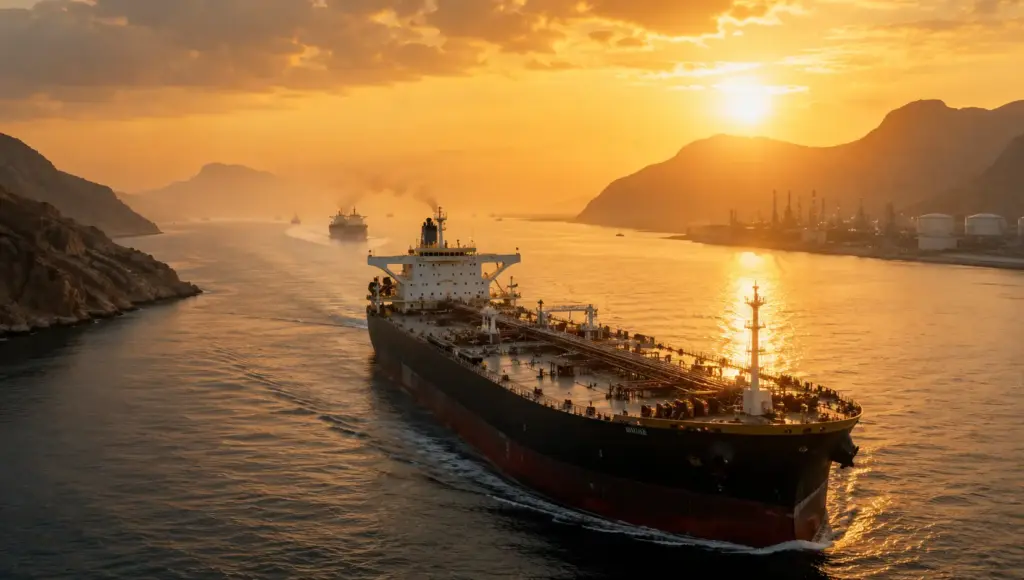
Hormuz risk returns to oil markets
The latest escalation centered on attacks on commercial vessels moving through or near the Strait of Hormuz. A Qatari LNG tanker was reported to be at risk after being hit, whilst a Saudi crude tanker was also damaged.
The US Navy-led Joint Maritime Information Center raised the threat level for transit through the strait to severe, citing a heightened risk environment for commercial shipping. The move came after several weeks in which traffic through the waterway had started to recover, though flows remained below pre-conflict levels.
Markets had begun to price in the possibility that the worst of the disruption had passed. Oil had eased from earlier conflict-driven highs, and attention was shifting back towards inflation data, central-bank policy and demand conditions. The latest attacks challenge that assumption.
The development also reverses part of the calmer tone seen late last month, when crude prices eased after renewed US-Iran talks and markets started to reduce the immediate risk premium attached to Middle East supply routes.
Why the Strait matters
The Strait of Hormuz is not an ordinary shipping route. It is a narrow passage linking the Gulf with global markets and is used for a significant share of the world’s oil and LNG exports. It makes any threat to shipping through the area a market-sensitive event. A single incident may not be enough to cause a sustained price shock, but repeated attacks, higher insurance costs, rerouting, vessel delays or reduced willingness among shipowners to enter the area can all affect the supply picture.
This is why oil markets do not only react to whether barrels are physically lost. They also react to confidence. If producers can pump crude but cannot reliably ship it, or if buyers have to pay a higher risk premium to secure cargoes, the effect can still be felt in prices.
For now, the market is essentially dealing with uncertainty rather than a full closure. A complete interruption would be a much larger event. However, even without that, the return of severe shipping-risk warnings is enough to make oil more sensitive to headlines from the region.
Oil prices respond to a fragile ceasefire
The latest price move reflects a reassessment of the recent US-Iran détente. The United States revoked a licence that had allowed Iranian oil sales, whilst US forces reportedly launched new strikes following the vessel attacks. That shifts the story away from a steady reopening of the strait and back towards a more unstable phase, where diplomacy, maritime security and sanctions policy are moving together.
Oil traders have already seen how quickly the market can change direction during this conflict. Earlier relief over renewed talks helped pull crude lower. Now, the return of direct shipping risk has lifted prices again.
The larger question is whether this remains a short-lived risk premium or becomes a more persistent supply concern. That will depend on whether shipping continues, whether further vessels are targeted and whether Washington and Tehran can prevent the latest escalation from undermining broader talks.
Inflation pressure is back in the conversation
Higher oil prices quickly feed into wider market expectations because energy remains one of the clearest links between geopolitics and inflation. If crude continues to rise, investors may become more cautious about assuming that inflation pressure will fade. This is important for central banks, bond yields and currencies, especially if higher energy costs coincide with already firm price data.
The dollar can also benefit in this kind of environment, particularly when geopolitical risk is paired with expectations of tighter US policy. Gold may attract safe-haven interest, but that support can be limited when yields and the dollar are rising at the same time.
It does not mean every oil move will produce the same reaction across markets. Much depends on whether the price rise is seen as a temporary shock or the start of a more durable energy squeeze.
Execution risk can rise quickly
For retail market participants using leveraged products, the practical risk is not only the direction of oil prices, but how fast conditions can change.
Geopolitical headlines can trigger sharp intraday moves, wider bid-ask spreads and less predictable execution, particularly in oil CFDs, gold, index products and currency pairs tied to inflation and risk sentiment. This is where market structure becomes important, because spreads can widen quickly during volatility even when a platform normally shows tight pricing in calmer conditions.
The risk is higher around thin-liquidity windows, unexpected official statements or sudden reports of further vessel damage. Stops may still help limit risk, but they cannot guarantee execution at a chosen level if prices gap or liquidity deteriorates.
What to watch next
The next test is whether shipping through the Strait of Hormuz continues to recover or slows again. Markets will be watching vessel traffic, insurance costs, official comments from the United States, Iran and Gulf states, and any sign that energy producers are changing export plans. Oil prices may also react to US inventory data and broader demand signals, but the immediate driver is now the security of Gulf shipping.
The current situation does not yet point to a full-scale energy shock. However, it has made clear that the market’s recent calm was conditional. As long as the Strait of Hormuz remains exposed to further disruption, oil prices are likely to keep carrying a geopolitical risk premium.