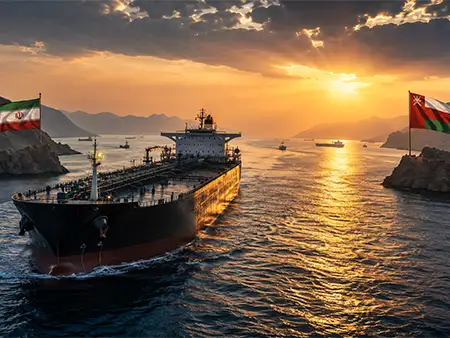
Brent and WTI rebounded as the threat of an indefinite US blockade of Iran revived supply concerns, with disruption through the Strait of Hormuz increasingly reshaping global crude trade.

Brent and WTI rebounded on Friday after the United States threatened to maintain its naval blockade of Iran indefinitely, reviving concerns over prolonged disruption to oil flows through the Strait of Hormuz.

Oil prices climbed on Friday, 14 August 2026, as renewed tensions between the United States and Iran brought supply risks back to the forefront, reversing part of the previous session’s sharp decline and putting Brent and WTI on course for weekly gains.
Brent crude rose around 1.6% to $88.50 a barrel during Friday trading, whilst US West Texas Intermediate (WTI) gained about 1.9% to $82.81. The rebound followed a fall of more than 2% on Thursday, when an unexpectedly large increase in US crude inventories and weaker global demand forecasts briefly outweighed geopolitical concerns.
Sentiment shifted again after Washington said its naval blockade of Iran could remain in place indefinitely following stalled ceasefire negotiations. The prospect of a prolonged confrontation has renewed concern over shipments through the Strait of Hormuz, one of the world’s most important energy corridors and a route normally used for around one-fifth of global oil and liquefied natural gas flows.
The latest price reversal highlights an increasingly difficult market for oil traders. Weakening demand expectations and rising inventories are exerting downward pressure on crude, but developments in the Middle East continue to create the potential for abrupt supply shocks and sharp changes in the geopolitical risk premium.
Hormuz disruption remains central to oil prices
Shipping activity through the Strait of Hormuz remains heavily constrained as the confrontation between Washington and Tehran continues. Commodity vessel traffic increased to nine transits on Thursday from five a day earlier, according to shipping data cited by Reuters, but remained below the August average of around 12 vessels per day. Most of the vessels that did make the passage travelled through Iranian-controlled routes.
The United States and Iran are also making competing claims over control of the waterway. Washington has threatened to maintain pressure on Tehran after ceasefire negotiations failed to produce an agreement, whilst Iranian officials have continued to assert control over passage through the strait.
The security risk was reinforced after the United Arab Emirates accused Iran of attacking two vessels belonging to Abu Dhabi National Oil Company while they were travelling through Hormuz shipping routes. No injuries were reported and ADNOC said the situation had been brought under control, but the incidents underline the risks facing commercial shipping in the region.
For energy markets, the significance extends well beyond Iranian exports. Saudi Arabia, the UAE, Iraq, Kuwait and other major producers rely heavily on Gulf shipping routes, meaning sustained disruption can affect a much larger portion of global supply than Iran’s own production alone.
Asian refiners are already changing where they buy crude
Evidence that the disruption is affecting physical oil trading is becoming increasingly visible. Asian refiners are buying more US crude as the uncertainty around Hormuz makes Middle Eastern supply less predictable. US crude exports to Asia reached a record 2.35 million barrels per day in July, according to shipping data reported by Reuters, as refiners sought alternatives to barrels normally sourced from the Gulf.
This illustrates how geopolitical disruption can reshape oil markets even when crude continues to flow. Refiners must consider not only the headline price of oil but also freight costs, insurance, shipping delays and the possibility that cargoes could become stranded or attacked. Longer supply routes can therefore increase the effective cost of securing crude even without a complete closure of Hormuz.
India has also increased its dependence on Russian crude as Middle Eastern supplies have been disrupted. Russia accounted for more than half of Indian crude imports in July, highlighting how the conflict is redirecting trade flows between some of the world’s largest producers and consumers.
The longer disruption persists, the greater the potential for these changes to influence regional crude prices, tanker rates and refining margins.
Huge US inventory build limits the rally
The geopolitical backdrop is strongly supportive for oil, but Friday’s rebound comes against increasingly bearish market fundamentals. US crude inventories surged by 17.4 million barrels in the latest reporting week, the largest increase since January 2023. The unexpectedly large build helped drive Brent down $1.91 to $87.07 on Thursday, while WTI dropped $2.02 to $81.25.
Demand expectations have also weakened. OPEC has lowered its forecast for global oil-demand growth in 2026 and the International Energy Agency has reduced its consumption outlook as higher energy prices and disruption from the Middle East conflict weigh on economic activity.
These developments are preventing geopolitical risk from translating automatically into substantially higher oil prices. Instead, the market is being pulled between two powerful forces: the possibility of prolonged disruption to Middle Eastern supply and growing evidence that elevated energy prices are weakening consumption.
Oil traders face an unusually headline-sensitive market
The competing pressures have produced sharp swings in crude prices during recent sessions. Brent and WTI jumped around 5% on Monday as expectations for a US-Iran agreement deteriorated. Prices subsequently remained elevated before Thursday’s inventory and demand data triggered a sell-off of more than 2%. Friday’s geopolitical escalation then sent both benchmarks higher again.
For traders and investors, this sequence demonstrates just how quickly the dominant oil narrative can change. Inventory reports, OPEC and IEA forecasts remain important indicators of underlying supply and demand, but geopolitical headlines can rapidly overwhelm those signals when a major energy transit route is involved.
The risk is particularly relevant for traders using leveraged products such as CFDs, where abrupt price movements can magnify both gains and losses. Oil markets can also move outside the most liquid trading periods when political or military developments occur unexpectedly.
What happens next could depend on Hormuz
The immediate focus is likely to remain on shipping activity through the Strait of Hormuz and whether Washington and Tehran can revive negotiations.
A sustained recovery in vessel traffic or progress towards an agreement could remove part of the geopolitical premium currently supporting crude prices. Conversely, further attacks on tankers, tighter restrictions on passage or evidence of prolonged disruption could increase concerns over the availability of Middle Eastern supply.
The physical market is already adapting through increased US and Russian crude purchases, but replacing Gulf supplies involves different transport routes, costs and grades of oil.
For now, Brent’s recovery towards $89 shows that traders are unwilling to dismiss the geopolitical risk even after one of the largest US inventory builds in years.
The central question for oil markets is whether weaker consumption will be enough to offset the risk of a prolonged disruption to one of the world’s most important energy corridors.