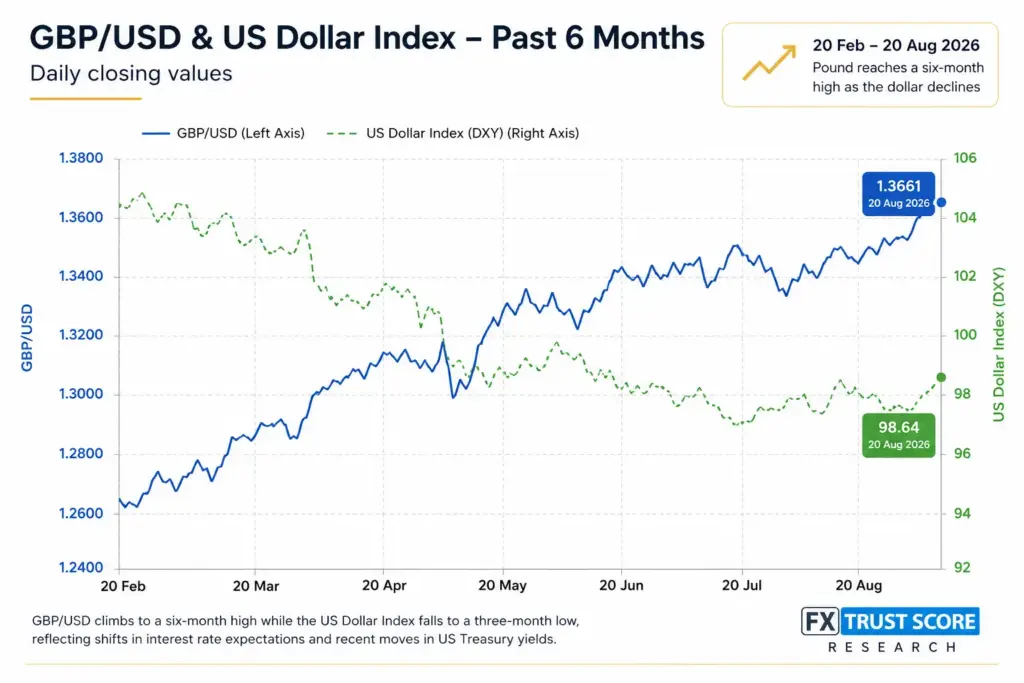
The pound has climbed to a six-month high against the US dollar as falling US Treasury yields and shifting interest-rate expectations reshape major forex markets.

Sterling has climbed to a six-month high against the US dollar as changing interest-rate expectations and a sharp reversal in US Treasury yields reshape the currency market. The euro has also strengthened, leaving traders watching whether the latest dollar decline has further to run.

Foreign exchange markets have moved firmly back into focus as the British pound strengthens, the US dollar retreats and changing expectations for interest rates create increasingly noticeable moves across the world’s major currencies.
GBP/USD climbed as high as $1.3661 on Thursday, 20 August 2026, its strongest level in six months. Sterling’s advance comes alongside broader weakness in the US currency, with the US Dollar Index falling below 99 to around 98.6-98.7, its lowest level since May. The euro has also benefited, with EUR/USD reaching around $1.169, whilst the Japanese yen has recovered some of the ground lost against the dollar earlier this summer.
The picture is therefore bigger than sterling alone. Several major currencies are strengthening against the dollar at the same time, suggesting that a change in the outlook for US interest rates and government bond yields has become an important force across the foreign exchange market.
For newer traders, understanding how currencies are traded in pairs helps explain why movements in the dollar can simultaneously affect GBP/USD, EUR/USD and USD/JPY.
Why is the US dollar falling?
One of the immediate catalysts for the latest dollar decline came from an unusual development in the US government bond market. The US Treasury announced on Wednesday that it would increase planned buybacks of longer-dated Treasury securities. The move followed a sharp sell-off in government bonds that had pushed the yield on the 30-year US Treasury above 5.33%, its highest level since 2007. Following the announcement, long-term yields fell sharply, with the 30-year yield moving back towards the 5.2% area.
This matters for currencies because interest rates and bond yields can influence where international investors choose to hold their money. When US yields are particularly attractive compared with those available elsewhere, demand for dollar-denominated investments can increase, providing support for the US currency. If those yields fall, part of that advantage can disappear.
The Treasury’s action therefore had an important secondary effect. Although it was aimed at improving conditions in the government bond market, the subsequent decline in yields removed some of the support that the dollar had been receiving from high US borrowing costs.
There is an important distinction, however. The Treasury’s bond buybacks are not the same as the Federal Reserve cutting interest rates, nor do they represent a new programme of quantitative easing. They are designed primarily to improve liquidity in parts of the Treasury market. That means the recent fall in US yields could still reverse if concerns about inflation, government borrowing or the country’s fiscal outlook return to the forefront.
Why is the pound strengthening?
Dollar weakness explains only part of sterling’s rise. Developments in the UK are also giving investors reasons to reassess the outlook for the pound. British inflation remains relatively high, creating a difficult situation for the Bank of England. Policymakers need to control price pressures without putting unnecessary strain on an economy where employment and growth indicators have been less convincing. The persistence of inflation means financial markets continue to see the possibility of higher UK interest rates, even though the economic outlook remains mixed.
That expectation matters for sterling. If investors believe UK rates will remain comparatively high – or could rise further – pound-denominated assets can become more attractive. At present, GBP/USD is therefore benefiting from developments on both sides of the exchange rate: the pound is receiving support from UK interest-rate expectations while the dollar has been weakened by falling US Treasury yields.
This combination helps explain why sterling has been able to reach its highest level against the dollar in six months.
EUR/USD shows this is not just a sterling story
The euro’s performance provides an important clue about what is happening in the wider currency market. EUR/USD has climbed towards $1.17, reaching levels not seen since May.
If the pound were rising strongly while the euro remained largely unchanged, the move could more easily be described as a sterling-specific story. Instead, both currencies have strengthened against the dollar, alongside gains in several other major currencies. That points towards broad US dollar weakness as an important part of the current market move.
For traders, watching sterling and the euro together can therefore provide useful context. If GBP/USD and EUR/USD continue advancing at the same time, that would reinforce the view that the dollar remains under broad pressure. If sterling continues higher while the euro begins to struggle, UK-specific factors could be playing a greater role.
The Japanese yen tells another part of the story
USD/JPY is also worth watching because the yen has been one of the currencies most affected by the large gap between US and Japanese interest rates.
Earlier this summer, the yen weakened dramatically and USD/JPY moved towards levels around 164. US and Japanese authorities subsequently carried out a rare coordinated intervention aimed at slowing the decline. The exchange rate has since moved back towards 158, meaning the yen remains historically weak but has recovered from its recent extremes.
The direction of US Treasury yields is particularly important here. High US yields have encouraged investors to favour dollar assets over lower-yielding Japanese alternatives. If US yields continue to retreat, that difference becomes less pronounced and some of the pressure on the yen can ease.
USD/JPY therefore gives traders another way of assessing the dollar story. Continued yen strength alongside gains in sterling and the euro would provide further evidence that the dollar’s weakness is broad rather than confined to one currency pair.
The Federal Reserve could still change the picture
Despite the recent fall in the dollar, there are good reasons for traders to remain cautious about assuming that the trend will simply continue. Minutes from the Federal Reserve’s July meeting showed that policymakers remain concerned about inflation. Some officials were prepared to consider higher interest rates if price pressures failed to move sustainably towards the Fed’s 2% target. That is important because it shows that the central bank itself has not necessarily become significantly more relaxed about inflation, even as Treasury yields have fallen.
This leaves currency markets balancing two competing forces. Recent developments in the bond market have weakened the dollar, but the Federal Reserve has not clearly turned dovish. If forthcoming US inflation, employment or economic data cause investors to expect higher interest rates again, Treasury yields could recover and the dollar could regain some of its recent losses.
That uncertainty is one reason the current foreign exchange environment is particularly interesting. Expectations can change quickly when new economic data arrive, and currencies often react immediately when investors reassess where interest rates are heading.
High oil prices add another complication
Foreign exchange traders also need to consider what is happening in energy markets. Brent crude has climbed above $90 a barrel as disruption around the Strait of Hormuz and continuing Middle East tensions restrict normal energy flows.
Oil matters to currencies because countries are affected differently by higher energy prices. Large oil importers can face higher costs and greater inflationary pressure, while energy-exporting economies may benefit from stronger revenues. Persistent high oil prices can also make central-bank decisions more difficult because higher transport and energy costs can feed through into consumer prices.
That is especially relevant now. Central banks are already trying to determine whether inflation has been brought under control, and another sustained increase in energy costs could complicate those calculations. The oil market is therefore another variable capable of influencing interest-rate expectations and, ultimately, currency valuations.
What should forex traders watch now?
Rather than presenting one obvious trade, the current environment offers several important relationships for traders to follow.
GBP/USD is testing its strongest levels in six months, making the durability of sterling’s advance an obvious focus. If UK interest-rate expectations remain elevated while US yields stay under pressure, the conditions that supported the recent rise would remain in place. A recovery in US yields or a change in expectations for Bank of England policy could alter that picture.
EUR/USD provides a useful measure of whether dollar weakness remains broad. The pair’s move towards $1.17 has accompanied sterling’s advance, so continued strength in both currencies would reinforce the wider dollar story.
USD/JPY, meanwhile, remains particularly sensitive to US bond yields. It also carries the additional complication of possible official intervention if the yen again becomes excessively weak.
The US Dollar Index around the 99 level provides another simple reference point. Sustained weakness below that area would indicate that the dollar remains under pressure against a basket of major currencies, while a recovery could suggest that the recent sell-off is beginning to lose momentum.
These are not guarantees about where exchange rates will move next. They are reference points that can help traders understand whether the forces currently driving the market are strengthening or beginning to reverse.
What could reverse the current moves?
The most obvious threat to the present trend would be another rise in US Treasury yields. The Treasury’s decision to increase bond buybacks has helped calm the bond market, but it has not removed the underlying concerns surrounding US inflation, government borrowing and the country’s fiscal position. If those concerns push yields higher again, dollar-denominated assets could become more attractive and the US currency could recover.
Economic data will therefore be particularly important. Stronger-than-expected US inflation or employment figures could cause markets to reconsider the outlook for Federal Reserve policy. Conversely, weaker data could reinforce expectations that US rates have little reason to rise further, potentially maintaining pressure on the dollar.
Sterling has risks of its own. UK inflation may be supporting expectations for higher interest rates, but employment conditions have weakened and economic growth remains subdued. If investors begin to believe that the Bank of England cannot tighten policy as much as currently expected, some of sterling’s support could disappear.
The present moves should therefore be understood as the result of changing economic expectations rather than the beginning of a predetermined trend.
Forex markets enter a more active phase
The latest moves illustrate how quickly the balance of power in currency markets can change. Only days ago, surging US Treasury yields were providing support to the dollar. The subsequent reversal in those yields has helped weaken the US currency and allowed sterling and the euro to advance.
The pound reaching a six-month high is one of the clearest signs of that shift, but it is not the whole story. Sterling strength, euro gains, dollar weakness, changing Treasury yields, persistent UK inflation, Federal Reserve uncertainty and elevated oil prices are all interacting at the same time.
For traders and investors, understanding how forex trading works and how these economic forces affect currency pairs is more useful than simply knowing that one currency has risen and another has fallen. The next stage of the move will depend on whether the economic conditions behind it continue to hold — and that makes upcoming inflation, employment, interest-rate and bond-market developments particularly important to watch.