Artificial intelligence is creating a widening divide across technology stocks. Chip and infrastructure companies are benefiting from surging computing demand, while software shares face growing questions over disruption, pricing power and future profits.

Artificial intelligence is no longer lifting technology stocks indiscriminately. Semiconductor and infrastructure companies are attracting fresh capital as demand for computing power accelerates, while parts of the software sector are being marked down over fears that increasingly capable AI systems could challenge established products and business models.
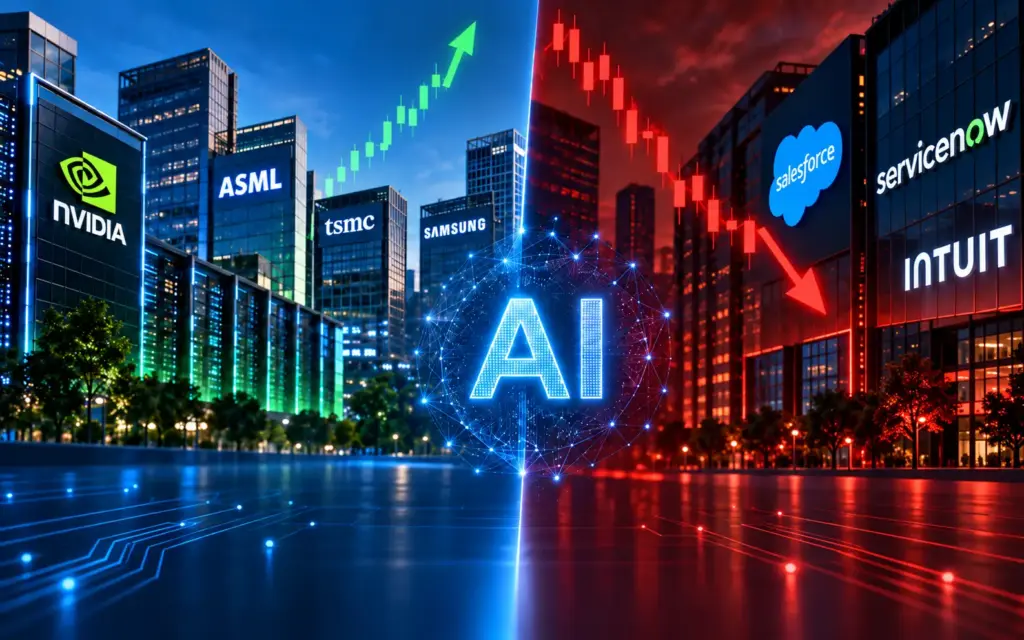
The latest market moves are exposing a divide that has been slowly developing beneath the surface of the AI rally for some time. Investors still appear willing to pay for companies supplying the physical infrastructure needed to build and operate artificial intelligence, but enthusiasm is becoming much more selective when AI is viewed as a potential competitor rather than a source of additional demand.
For anyone trading technology shares, this may be of particular interest. The next stage of the AI investment cycle may be more about determining whether AI strengthens or threatens the economics of each business, and less about identifying companies associated with artificial intelligence.
Software stocks come under renewed pressure
The pressure has been particularly visible among large enterprise-software companies such as Salesforce and Intuit, whose shares fell by around 4% in the latest US session, whilst ServiceNow lost roughly 5%, contributing to an overall 1.4% decline in the broader software and services sector.
An immediate concern is that increasingly capable generative AI systems could perform more of the work currently handled by specialised software products. Coding, customer support, data analysis, workflow automation and business intelligence are all areas where AI capabilities are advancing quickly, raising questions over how much companies will continue paying for individual software applications if broader AI platforms can perform overlapping tasks.
It does not mean that established software businesses would suddenly become obsolete. Large corporate customers have invested years building workflows, databases, permissions and integrations around platforms such as Salesforce and ServiceNow, making wholesale replacement both expensive and operationally difficult. Many incumbent software companies are also incorporating AI directly into their own products, which could ultimately strengthen their position.
The market, however, does not need proof that disruption will occur before share prices react. Investors price probabilities, and the possibility that AI could reduce pricing power, increase competition or force software companies to spend more heavily on product development is enough to change valuation assumptions.
Chipmakers are benefiting from the opposite side of the trade
Semiconductor companies face a very different relationship with artificial intelligence because advanced AI systems require enormous amounts of computing power regardless of which software provider ultimately wins. This is why parts of the chip sector have been rising even when software shares are under pressure. Intel gained around 9% in the latest session and Qualcomm rose more than 3% following developments involving AI-chip collaboration with Amazon. Broadcom also advanced, reinforcing the sense that investors remain willing to back companies supplying the infrastructure underpinning the AI expansion.
Meanwhile, Nvidia fell by around 2%, even as several semiconductor peers gained, which demonstrates that investors are also becoming more selective within the hardware trade itself. After exceptional gains and enormous expectations around AI spending, individual chip stocks can be vulnerable to valuation concerns even when the broader industry backdrop remains favourable.
This increasingly selective behaviour follows a pattern FXTrustScore has already examined in AI stocks diverging as investors pick winners in the infrastructure boom. The common theme is that exposure to artificial intelligence alone is becoming less important than the quality, economics and durability of that exposure.
Asia remains at the centre of the hardware boom
The hardware side of the AI trade extends well beyond US-listed semiconductor companies. Asian markets have become central to the investment story because South Korea, Taiwan and Japan occupy critical positions across memory chips, advanced manufacturing and semiconductor equipment.
Earlier this week, Samsung Electronics climbed more than 5% and SK Hynix rose around 8% as renewed enthusiasm for advanced AI models strengthened expectations for memory demand. South Korea’s Kospi surged as semiconductor shares led the market higher, while Japanese chip-related companies also recorded strong gains.
Memory has become particularly important because increasingly sophisticated AI models require vast quantities of data to be moved quickly between processors. High-bandwidth memory, or HBM, is therefore becoming one of the most strategically valuable parts of the AI supply chain, giving companies such as SK Hynix and Samsung direct exposure to rising computing requirements.
Taiwan also remains indispensable through TSMC, which manufactures many of the world’s most advanced processors. Europe has its own critical position through ASML, whose lithography systems are required to produce leading-edge semiconductors. This means the hardware boom is inherently global even though much of the attention surrounding AI investing continues to focus on the largest US technology companies.
AI spending is moving deeper into physical infrastructure
One reason hardware stocks continue to attract investors is that the amount of physical infrastructure required to support artificial intelligence keeps expanding. AI models require processors, memory, networking equipment, data centres, cooling systems and increasingly large amounts of electricity. Each additional generation of more capable models can therefore increase demand across several layers of the supply chain rather than benefiting a single group of chipmakers.
This is also essentially why the AI investment theme is beginning to spread into sectors that would once have seemed far removed from software. Utilities, power equipment manufacturers and even industrial commodities are becoming linked to the build-out as data centres compete for electricity and governments invest in stronger transmission networks.
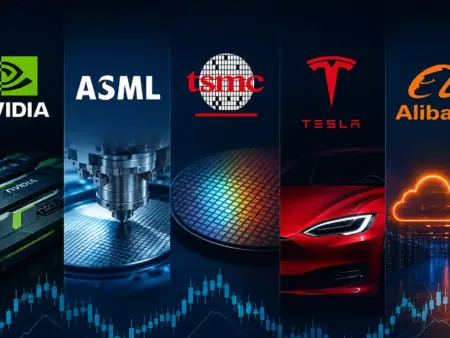
FXTrustScore’s recent 5 Stocks in Focus: Nvidia, ASML, TSMC, Tesla and Alibaba examined how differently companies participate in the AI economy. The latest market divergence is taking that distinction further, with investors increasingly separating the businesses selling scarce infrastructure from those whose established products may face greater competitive pressure.
Why software faces a harder valuation question
Software has traditionally been highly attractive to equity investors because successful products can scale without requiring proportionate increases in physical investment. Once developed, another software subscription can often be sold at relatively low additional cost, helping established companies generate strong margins and cash flow.
Generative AI potentially complicates that model in two ways. First, software companies may need to spend more aggressively on computing infrastructure and AI development merely to remain competitive. Secondly, customers may begin questioning whether they need as many separate applications if AI platforms can perform tasks that previously required specialised software.
There is nevertheless a strong counterargument in that Enterprise software providers possess valuable customer relationships, proprietary data and deeply embedded workflows that new AI companies cannot easily replicate. Rather than being replaced, some established platforms could become the distribution layer through which businesses actually use artificial intelligence.
For investors, the debate is therefore not simply whether software wins or loses. It is about which companies can integrate AI without destroying the economics that made their businesses attractive in the first place.
Infrastructure winners are not risk-free
The apparent strength of semiconductor and infrastructure companies should not be interpreted as evidence that their shares can rise indefinitely. AI infrastructure spending has reached extraordinary levels, and some valuations already assume that investment will continue growing rapidly for years. If cloud providers eventually moderate capital expenditure, or if computing becomes materially more efficient, revenue expectations across the semiconductor supply chain could be reassessed quickly.
Competition is another consideration. Nvidia remains dominant in advanced AI accelerators, but Intel, AMD, Qualcomm and a growing number of custom-chip developers are all competing for parts of the market. Major technology companies are also designing proprietary processors in an effort to reduce their dependence on external suppliers.
Memory producers face a more traditional cyclical risk. Strong demand can lead manufacturers to expand capacity, eventually creating excess supply and falling prices. Semiconductor investors therefore still need to distinguish structural AI growth from the industry’s long-established tendency towards boom-and-bust cycles.
Investors are beginning to demand proof
The broader change taking place across technology stocks is one of expectations. During the earliest phase of the generative AI boom, announcing an AI strategy could be enough to attract investor attention. Companies were frequently rewarded for demonstrating that they were participating in a market expected to transform large parts of the global economy. This threshold has risen considerably and investors increasingly want evidence of revenue, margins, market share and defensible competitive advantages, particularly as the amounts being invested become larger.
Software companies must demonstrate that AI can enhance their products without undermining subscription revenues. Semiconductor businesses must show that the infrastructure boom can support earnings strong enough to justify elevated valuations. Cloud providers must prove that hundreds of billions spent on computing capacity can eventually generate attractive returns. The result is perhaps a more mature and considerably more complicated AI trade.
What traders should watch next
For semiconductor stocks, capital expenditure by major cloud providers remains one of the clearest indicators of underlying demand. Continued increases would support the argument that the infrastructure cycle still has considerable room to run, particularly for advanced processors, memory and networking equipment.
Software investors will be watching a different set of signals. Customer retention, pricing, AI-related revenue and margins will become increasingly important as companies try to demonstrate that generative AI is an opportunity rather than an existential threat.
Earnings guidance may therefore produce much greater divergence between individual technology shares than investors became accustomed to during the broad AI rally. A company reporting strong growth but disappointing AI monetisation could be punished, while another may be rewarded for demonstrating that new AI capabilities are strengthening its existing business.
There is also a wider market risk. Technology valuations remain sensitive to bond yields and interest-rate expectations, while geopolitical tensions and higher oil prices continue to complicate the inflation outlook. Even strong AI fundamentals cannot completely insulate growth stocks from a broader repricing of financial markets.
The central investment theme, however, is becoming increasingly clear. Artificial intelligence is no longer one trade. It is becoming a competitive force that creates demand in some industries, threatens established economics in others and forces investors to decide which companies possess genuine long-term advantages.
For traders, identifying that difference may prove much more valuable than simply asking whether a stock has exposure to AI.