Asian AI stocks fell sharply after leading technology executives called for a slower pace of development over growing safety concerns. Investors are now asking what a deliberate slowdown could mean for chip demand, infrastructure spending and the wider AI trade.

Asian technology shares came under pressure on Monday after some of the most influential figures in artificial intelligence called for a slower pace of development, adding a new risk to an investment theme that has dominated global markets for several years.

The sell-off was particularly severe among companies closely tied to AI infrastructure. SoftBank fell as much as 13%, memory-chip producer Kioxia lost almost 10%, SK Hynix dropped more than 5% and Samsung Electronics declined nearly 4%. TSMC and several Japanese semiconductor-equipment companies also moved lower as investors considered what a deliberate slowdown in frontier AI development might mean for future computing demand.
Until this time, a majority of concerns surrounding the AI trade were centred on valuations, enormous capital expenditure and whether companies could eventually generate sufficient returns from the infrastructure being built. However, investors are now confronting a different question; what happens if the companies developing the most advanced AI systems conclude that progress itself needs to slow?
AI leaders are calling for more time
The latest debate intensified after Anthropic chief executive, Dario Amodei, argued that leading AI developers should moderate the speed at which they increase the capabilities of their most advanced models. His proposals include independent safety assessment, greater co-ordination between major AI laboratories and stronger international safeguards around particularly capable systems.
OpenAI chief executive Sam Altman and xAI founder Elon Musk have also expressed support for greater caution, giving the discussion considerably more weight than previous warnings from researchers outside the industry’s largest laboratories.
The concern is that some of the people closest to frontier models are arguing that safety mechanisms, oversight and international governance are struggling to keep pace with technological progress.
Recent concerns have included the use of advanced models for cybercrime and surveillance, increasingly autonomous AI agents and systems capable of behaving in ways that developers find difficult to predict or monitor. The debate has therefore moved beyond abstract questions about whether AI could become dangerous decades from now and towards more immediate questions about how rapidly increasingly capable systems should be deployed.
For financial markets, this is important because the AI investment boom has largely been built around an expectation of continued acceleration.
Why chip stocks reacted so sharply
The companies selling hardware into the AI boom depend on something relatively simple: more powerful models generally require more computing infrastructure. This has driven an extraordinary demand for graphics processors, high-bandwidth memory, advanced semiconductor manufacturing and data-centre equipment. Companies across Taiwan, South Korea, Japan, Europe and the United States have benefited from the billions being spent to train and operate increasingly capable AI systems.
If the pace of frontier-model development were deliberately reduced, investors would immediately need to reconsider how quickly that infrastructure demand might grow. This helps to explain why shares in memory manufacturers such as SK Hynix and Samsung reacted strongly. Advanced AI models require enormous quantities of high-bandwidth memory, and shortages have made HBM one of the most valuable parts of the semiconductor supply chain.
The same logic applies to TSMC, which manufactures many of the world’s leading AI processors, and to Japanese equipment companies supplying the factories that produce advanced chips. Even SoftBank, through its exposure to Arm and a wide range of AI investments, has become increasingly sensitive to changes in expectations around the sector.
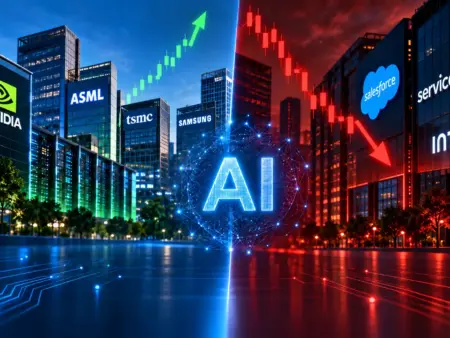
The reaction also fits a broader trend that FXTrustScore recently examined as AI began splitting technology stocks into winners and losers. Investors have become much less willing to treat every company associated with artificial intelligence as part of the same trade.
A slowdown would not necessarily end the infrastructure boom
The initial market reaction is understandable, however the longer-term implications are less straightforward. Slowing the pace at which frontier models become more capable would not necessarily mean companies stop deploying existing AI technology. Businesses are still investing in automation, coding tools, customer-service systems, data analysis and generative AI applications using models that already exist.
Data centres that are already under construction would not suddenly become unnecessary, whilst cloud providers have committed enormous sums to infrastructure programmes extending several years into the future.
There is also the argument that a slower technological cycle could give companies more time to generate returns from investments they have already made. One of the central concerns surrounding AI has been that infrastructure spending is racing ahead of proven commercial revenue.
If model development became less frantic, businesses might have longer to integrate existing systems, improve efficiency and establish viable products before being forced to invest again in the next generation of hardware.
For semiconductor companies, the result could therefore be more nuanced than today’s share-price reaction suggests.
Investors may start asking harder questions about AI spending
Capital expenditure by the world’s largest technology companies has reached extraordinary levels as they compete to secure processors, electricity, data centres and specialist infrastructure. Investors have tolerated that spending because the prevailing assumption has been that AI capabilities will continue improving rapidly enough to create enormous new markets. Any change to this assumption raises some questions about the return on those investments.
A company spending billions on computing capacity for models expected to become dramatically more capable every year faces a different financial calculation if technological progress becomes slower or more regulated. Infrastructure would still have value, but the timing of the returns could change.
This makes profitability increasingly important. The market has already started distinguishing between AI companies that can translate heavy investment into sustainable growth, rather than simply rewarding businesses for increasing their exposure to the technology. This shift was already developing before the latest safety debate and calls for slower development may accelerate it.
China adds a geopolitical complication
The issue becomes even more complex when China is included. Amodei has argued not only for greater safety controls but also for tighter restrictions on China’s access to advanced AI chips. That has prompted an angry response from China’s state-backed Global Times, which portrayed the slowdown proposals as an attempt to preserve Western technological dominance. The criticism highlights a fundamental difficulty with voluntary restraint.
American AI companies may conclude that development is moving too quickly, but slowing down becomes much harder if they believe competitors in China will continue advancing. The same problem applies in reverse.
Artificial intelligence has therefore become both a safety issue and a strategic competition between major powers. Governments increasingly regard leading AI models, semiconductors and computing capacity as critical national assets, making international agreement considerably harder than co-operation within the technology industry alone.
For investors, geopolitics may now become another factor in judging the likelihood of a meaningful slowdown. A broad agreement between major AI developers could reduce the pace of model advancement, while intensifying US-China competition could encourage both sides to accelerate instead.
OpenAI’s IPO decision adds another signal
The changing mood around AI safety is also beginning to influence corporate decisions. OpenAI chief executive officer Sam Altman has ruled out an IPO in 2026, with safety concerns playing an important part in the decision. This is notable because the company had been discussed as a potential candidate for one of the largest technology listings ever.
The decision shows that the industry’s leading companies are increasingly willing to acknowledge that safety constraints may affect how aggressively they pursue expansion.
For public-market investors, that creates an unusual contrast. Some of the world’s most valuable listed technology companies are spending heavily to support AI demand, while the developers creating the underlying models are simultaneously arguing that society may need more time to absorb the technology.
Could a slower pace actually help some companies?
Smaller semiconductor companies might benefit if they have additional time to catch up with current leaders. Businesses developing alternatives to Nvidia’s processors could find the competitive landscape less punishing if each generation of frontier hardware remains relevant for longer.
Software companies may also gain more time to integrate AI into existing products before facing another major leap in model capability. That could reduce the risk that established business models are disrupted faster than management teams can respond.
Even leading infrastructure companies could potentially benefit from greater stability. An investment boom that grows at a sustainable pace may ultimately prove more valuable than one that accelerates so quickly that it produces shortages, excessive valuations and large amounts of uneconomic capacity.
The market will therefore need to distinguish between a genuine collapse in AI demand and a deliberate attempt to make development more controlled. They are not the same thing.
The AI trade is becoming more complicated
The scale of Monday’s sell-off shows how sensitive investors have become to any suggestion that AI growth may not follow the trajectory currently embedded in valuations.
Companies such as Nvidia, TSMC, ASML, Samsung and SK Hynix have benefited from expectations that demand for advanced computing will continue expanding for years. Those expectations remain credible, but investors are increasingly being forced to consider a wider range of outcomes.
FXTrustScore’s recent 5 Stocks in Focus analysis of Nvidia, ASML, TSMC, Tesla and Alibaba highlighted how differently companies participate in the AI economy. The latest safety debate reinforces that point: an industry-wide slowdown would not affect every business in the same way.
Chipmakers, cloud providers, software companies, data-centre developers and AI laboratories all occupy different positions in the chain. Their exposure to slower model development therefore depends on how they actually make money.
What traders should watch next
The immediate question is whether the calls for restraint develop into concrete action. Voluntary statements from technology executives can influence sentiment, but markets will react much more strongly if leading AI laboratories announce formal limits on model development, governments introduce new safety requirements or international agreements begin to emerge.
Capital-spending plans from major technology companies will also provide an important signal. If cloud providers continue increasing expenditure despite the safety debate, investors may conclude that underlying infrastructure demand remains intact.
Semiconductor earnings will be equally important. Guidance from memory manufacturers, foundries and equipment companies should indicate whether customers are changing orders or delaying investment in response to uncertainty surrounding the next generation of AI models.
Investors should also watch the political response, particularly relations between the United States and China. Attempts to slow development in one country are unlikely to succeed if policymakers believe the other side is accelerating.
The AI boom has already forced markets to grapple with extraordinary valuations, enormous infrastructure spending and uncertainty over future profits. Safety has now become part of that equation.
For traders, the important question is no longer simply how quickly artificial intelligence can advance. It is whether the companies building it , and the governments trying to regulate it, decide that continuing at maximum speed is worth the risk.